
Agriculture 4.0 – Agricultural robotics and automated equipment for sustainable crop production
This report presents and reflects on the opportunities that new technological developments related to automation and precision agriculture (e.g. robotics) can offer to agriculture in developing countries. These technologies are mainly targeted to support farmers that struggle with the cost of labour when harvesting crops and to tackle the declining availability of manpower for general cropping operations. This report also explores the possible applications of agricultural technology, presents the current trends and discusses some of the principle challenges to successful adoption for sustainable agricultural mechanization in developing countries.
Challenges and opportunities in measuring knowledge management results and development impact
The papers in this two-part special issue examine from a range of perspectives the challenges and opportunities in tracking and demonstrating the impact of managing knowledge both inside the walls (in organizations) and outside the walls (in the broader development context). Due to the high number of papers selected, they were divided into two issues, based on their completion dates. We would like to thank all Guest Editors who reviewed and provided feedback on the abstracts and papers, as well as other colleagues who kindly agreed to peer review papers and provide feedback to the authors. We would also like to thank the contributing authors for their papers and for their patience –it has taken considerably longer than we had anticipated to finalize this issue. Finally, we would like to recognize the dedication and hard work of the Editor-in-Chief, Sarah Cummings. It has been a pleasure to work with her on this issue and we look forward to contributing to and supporting the Journal well into the future as members of the team of Senior Editors.
The global divide in data-driven farming
Big data and mobile technology are widely claimed to be global disruptive forces in agriculture that benefit small-scale farmers. Yet the access of small-scale farmers to this technology is poorly understood. We show that only 24–37% of farms of <1 ha in size are served by third generation (3G) or 4G services, compared to 74–80% of farms of >200 ha in size. Furthermore, croplands with severe yield gaps, climate-stressed locations and food-insecure populations have poor service coverage. Across many countries in Africa, less than ~40% of farming households have Internet access, and the cost of data remains prohibitive. We recommend a digital inclusion agenda whereby governments, the development community and the private sector focus their efforts to improve access so that data-driven agriculture is available to all farmers globally.
Precision Agriculture to Digital Agriculture: A Literature Review
This paper tries to capture the evolution of Digital Agriculture based on the foundations of precision agriculture. The review of literature around the development of precision agriculture reveals that the data captured in the precision agriculture processes, if effectively used, can support extensive agronomic decision making. With the advent of artificial intelligence and machine learning (AI/ML), predictive and prescriptive analysis of even huge amounts of data is now possible. Digital Agriculture seeks to combine the power of AI/ML and data from precision agriculture to deliver decision support systems to farmers and in other aspects of the agricultural value chain. The prerequisites for Digital Agriculture to realise its full potential are business models that demonstrate clear economic benefits for the farmers and user-friendly design.
Guidelines For Adoption of ICTS in Rural Extension to Face and Overcome Emergencies
The emergencies generated by the effects of climate change, the high conflicts in the continent, and now by COVID-19, challenge the Rural Extension services to external changes. Today, these emergencies threaten the possibility of maintaining supply chains and food security and the life and well-being of the population.
The risks generated by these emergencies require a new approach to the adaptation, mitigation, and action processes. There is no doubt about the leading role that ICTs play in this context since they facilitate action during moments of crisis and generate a sustainable plan for the post-emergency. In this scenario, this policy note indicates the elements that must be taken into account in a roadmap that allows the efficient incorporation of ICTs into Rural Extension.
Women and Men in Small-scale Fisheriers and Aquaclture in Asia
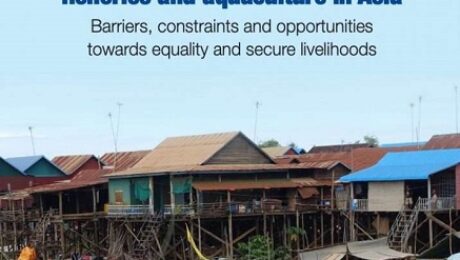
This study aims to consolidate the efforts to date to provide recommendations for action and future studies. Its objective is to answer the following questions for small-scale fisheries and aquaculture in Asia: (i) What is the division of labour between women and men in specific fisheries and aquaculture practices and what are the differences with respect to their access to assets, resources and entitlements? (ii) What are the drivers of such differences? (iii) What could be critical entry points and opportunities for addressing inequalities and discriminatory practices? To answer these questions, the study conducted an online literature search on gender and fisheries and aquaculture in Asia, selecting articles published between 2011 and 2021.
- Published in GENDER, ICTs, LIVESTOCK / FISHERIES, RESOURCES
Promoting the Development of Livestock Value Chains in Bangladesh to Reduce Poverty
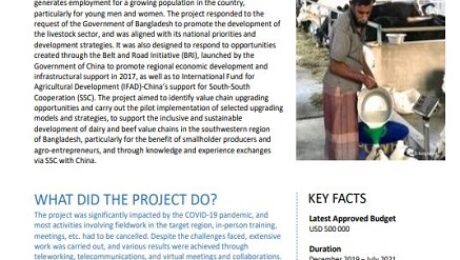
Bangladesh is a low income economy. The livestock sector is not only a source of income and nutritious food for rural households, it also generates employment for a growing population in the country, particularly for young men and women. The project responded to the request of the Government of Bangladesh to promote the development of the livestock sector, and was aligned with its national priorities and development strategies. It was also designed to respond to opportunities created through the Belt and Road Initiative (BRI), launched by the Government of China to promote regional economic development and infrastructural support in 2017, as well as to International Fund for Agricultural Development (IFAD) China’s support for South South Cooperation (SSC). The project aimed to identify value chain upgrading opportunities and carry out the pilot implementation of selected upgrading models and strategies, to support the inclusive and sustainable development of dairy and beef value chains in the southwestern region of Bangladesh, particularly for the benefit of smallholder producers and agro entrepreneurs, and through knowledge and experience exchanges via SSC with China.
- Published in LIVESTOCK / FISHERIES, RESOURCES
Emergency guidelines and standards for livestock in Pakistan
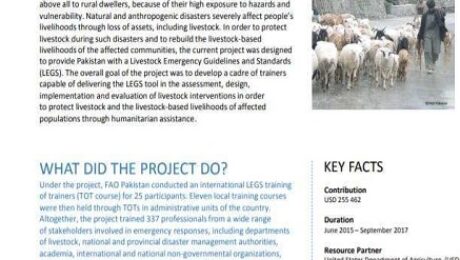
Around 62 percent of Pakistan’s population lives in rural areas, which are highly susceptible to natural disasters. Resource-poor rural households possess relatively high financial assets in the form of livestock and are largely dependent on animals for their food security and livelihoods. The impacts of disaster are extremely detrimental to the population, above all to rural dwellers, because of their high exposure to hazards and vulnerability. Natural and anthropogenic disasters severely affect people’s livelihoods through loss of assets, including livestock. In order to protect livestock during such disasters and to rebuild the livestock-based livelihoods of the affected communities, the current project was designed to provide Pakistan with a Livestock Emergency Guidelines and Standards (LEGS). The overall goal of the project was to develop a cadre of trainers capable of delivering the LEGS tool in the assessment, design, implementation and evaluation of livestock interventions in order to protect livestock and the livestock-based livelihoods of affected populations through humanitarian assistance.
- Published in LIVESTOCK / FISHERIES, PAKISTAN, RESOURCES
Agro-Ecological Zones in Punjab
A team of scientists and researchers from the University of Agriculture Faisalabad and University of Arid Agriculture Rawalpindi, in collaboration with FAO and Government of Punjab (Agriculture Department) worked together to delineate the Agro-Ecological Zoning (AEZ) in Punjab.
AEZ refers to the division of Punjab region into land resource mapping units, having a unique combination of landform, soil and climatic characteristics, and/or land cover.Based on the most up to date collected information on natural resources, climate and agricultural markets, AEZ reveals an enormous potential for crop diversification and productivity. And it is the need of the hour in a country where population is rapidly growing and where climate changes (increases in temperature, changes in rainfall pattern, extreme weather events) evidence the vulnerability of the current agricultural systems.From a side AEZ will help to make smallholder farming a profitable business and overall enhance agriculture efficiency.On the other side, policymakers will be able to use data of AEZ and associated information on land characteristics (soil quality, topography, agricultural land use, yeld etc) to formulate optimal policies for sustainable agricultural production.
- Published in AGROECOLOGY, PAKISTAN, RESOURCES
Pathways to Sustainable Agriculture
It draws on four books which address three themes central to understanding how pathways emerge in agriculture, and how sustainability, is or indeed is not, generated. The three themes are: framing (how we understand agriculture and its roles in development), practice (how agriculture and agricultural research is carried out, and by whom) and governance (how agriculture is regulated and controlled).
It includes chapters from 4 books:
Contested Agronomy: Agricultural Research in a Changing World
Regulating Technology: International Harmonization and Local Realities
Governing Agricultural Sustainability: Global Lessons from GM Crops
Adapting to Climate Uncertainty in African Agriculture: Narratives and Knowledge Politics
- Published in AGROECOLOGY, RESOURCES