
Emergency guidelines and standards for livestock in Pakistan
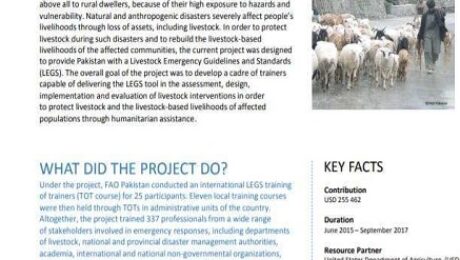
Around 62 percent of Pakistan’s population lives in rural areas, which are highly susceptible to natural disasters. Resource-poor rural households possess relatively high financial assets in the form of livestock and are largely dependent on animals for their food security and livelihoods. The impacts of disaster are extremely detrimental to the population, above all to rural dwellers, because of their high exposure to hazards and vulnerability. Natural and anthropogenic disasters severely affect people’s livelihoods through loss of assets, including livestock. In order to protect livestock during such disasters and to rebuild the livestock-based livelihoods of the affected communities, the current project was designed to provide Pakistan with a Livestock Emergency Guidelines and Standards (LEGS). The overall goal of the project was to develop a cadre of trainers capable of delivering the LEGS tool in the assessment, design, implementation and evaluation of livestock interventions in order to protect livestock and the livestock-based livelihoods of affected populations through humanitarian assistance.
- Published in LIVESTOCK / FISHERIES, PAKISTAN, RESOURCES
Family Farmers’ Cooperatives: Ending Poverty and Hunger in South Asia
Family farming is an integrated farming system, which produces diverse agricultural commodities that significantly contribute to improve food and nutrition security and income of the poor and marginalized group of people in the rural areas. As the reduced level of the economies of scale is a major challenge encountered by family farmers in the South Asia that could be addressed by farmers’ cooperatives approach. Strengthening the farmers’ cooperatives would increase the economies of scale that reduce the cost per unit in production and marketing of the products, and eventually support to improve food security, increase income and reduce poverty. This paper is based on the secondary data and literature review. Ending poverty and hunger targets of the Sustainable Development Goals (SDGs) by 2030 is possible through strengthening the family farmers’ cooperatives in South Asia by adopting some major policy interventions. Such interventions include: i) Effective implementation of the South Asia regional plan of action of UN Decade of Family Farming (UNDFF); ii) Increase the public and private investment in family farming and farmers’ cooperatives; iii) Emphasize the multidimensional approach of program implementation to the poor and marginalized people; iv) Promotion of Future Smart Food System such as nutrition sensitive agriculture and the utilization of neglected and underutilized nutrition rich crops; and v) Effective coordination and cooperation among different agencies at the country level (local, sub-national, and national levels), development partners, South-South counties, and North-South countries to contribute in attaining the targets of Sustainable Development Goals, particularly the No Poverty and Zero Hunger through farmers’ cooperatives in South Asia.
- Published in BANGLADESH, BHUTAN, INDIA, MALDIVES, NEPAL, PAKISTAN, PRODUCER ORGANISATION, SRI LANKA
Accelerating progress towards SDG2 – Policy effectiveness analysis
The Food and Nutrition Security Impact, Resilience, Sustainability and Transformation (FIRST) Programme represents a partnership between the Food and Agriculture Organization of the United Nations (FAO) and the European Union (EU). In 2018, the partnership agreed on the need to have a policy effectiveness analysis conducted in most of the FIRST countries.
As policy implementation rather than formulation is repeatedly raised as one of Pakistan’s challenges, this assessment considered the implementation challenges of specific policy processes relevant to the FAO-EU partnership in the country, rather than the entire suite of relevant policies. It considered the necessary conditions to move forward and how best to meet these conditions, including through more strategic resource allocation and more effective approaches to building institutional capacity.
- Published in PAKISTAN
Support for the Formulation of Projects for Strengthening Markets and Rural Transformation (Smart) Initiatives In Punjab, Pakistan
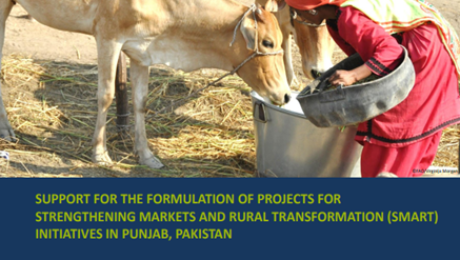
In Pakistan, the agriculture sector accounts for 19.8 percent of the gross domestic product and engages 42.3 percent of the labour force. The Province of Punjab is home to around 54 percent of the population and is the main production area for rice, cotton, sugar cane and mangoes, among other commodities. Moreover, Punjab accounts for 76 percent of national food grain production and over 60 percent of foreign exchange earnings from agriculture.
With the ongoing transformation of the rural landscape, larger farming operations are benefitting from the existing institutional structures to a substantially greater degree than smallholder farmers and both marginalized and landless populations. Acknowledging the requirement to facilitate more inclusive agricultural development, the Government of Punjab has endeavoured to revamp institutional structures to better ensure market liberalization and safeguard poor and marginalized populations. Hence, the Government of Punjab has undertaken the Strengthening Markets and Rural Transformation (SMART) Programme, which envisages policy and institutional reform, as well as increased investment in agriculture, livestock, irrigation and the management of both agroprocessing and supply chains.
- Published in PAKISTAN
Water availability, use and challenges in Pakistan – Water sector challenges in the Indus Basin and impact of climate change 2021
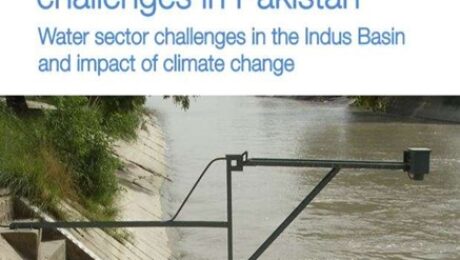
This working paper takes stock of Pakistan’s water resource availability, delineating water supply system and its sources including precipitation and river flows, and the impact of increasing climatic variability on the water supply system. In particular, the paper focuses on the current water usage and requirements in the agricultural sector, and how changing climatic conditions will affect the consumption patterns. With inflows expected to become more variable in the coming years, the severity of climatic extremities will become more pronounced, driving up water demands in addition to the demand increase from a rising population and urbanization. Over extraction of groundwater resources is also disturbing the water calculus and pushing the country towards a critical demand-supply gap.
- Published in NATURAL RESOURCE MANAGEMENT, PAKISTAN
Accounting of Water for Improved Management of Water Resources
Pakistan’s population is expected to reach 221 million by 2025 and, coupled with growing impacts of climate change, the country is expected to respond to pressures on limited water resources due to population growth and a growing need for climate resilient livelihoods. As such, federal and provincial Pakistani authorities have recognized the importance of ensuring water availability and access in order to adequately respond to national agricultural, sanitation and industrial needs. Agricultural production is especially important given that the agricultural sector consumes close to 90 percent of all currently available fresh water supplies in the country. While agriculture accounts for the overwhelming majority of water resources used, it is also the sector responsible for producing more than 90 percent of the country’s food supply and generating 75 percent of the country’s export revenues. Unsurprisingly, agriculture and food production account for 20 percent of Pakistan’s gross domestic product (GDP). Therefore, rural livelihoods are particularly vulnerable to climate-driven water scarcity, given the country’s largely arid to semi-arid climate and its high dependency on a single river system: the Indus River Basin System. Despite being the world’s largest contiguous irrigation system and the main water lifeline for Pakistan’s household consumption, sanitation and economic activities, there is insufficient data on water availability, use and governance specific to the Indus River Basin. Moreover, a marked increase in the number of private tube wells over the last 30 years has changed underground water pumping modalities. In light of the limited awareness on the importance of joint efforts for water management, the project helped establish these links between different uses of water along multiple sectors and locations around the country. It convened actors to assess water governance through a systems approach, where the concerns and priorities of all stakeholders concerned were reflected and understood by others.
- Published in NATURAL RESOURCE MANAGEMENT, PAKISTAN
Just-in-Time Policy Note on Agriculture and Food in Pakistan | Resilient Systems: Moving Beyond the COVID-19 Crisis
The Partnership for Agricultural Transformation in Pakistan (PAT-P) is a coalition of multilateral international agencies that aim to transform agriculture into a dynamic, competitive, efficient and climate smart sector, and to reposition it as an engine of growth in rural areas. The coalition assists the Government in implementing a policy framework and take reform actions that are potentially of high impact and politically critical.
This Just-in-Time Policy Note examines the impact of the COVID-19 pandemic on Pakistan’s food system and provides recommendations on key policy actions and adjustments to make the food systems more resilient to future shocks.
- Published in PAKISTAN
Multi-criteria decision analysis for selection of vulnerable districts
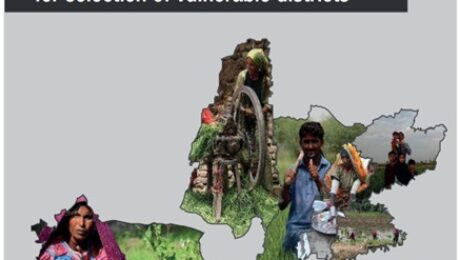
Modelling of climate change scenarios for Pakistan indicates that if agriculture and water management in the Indus River Basin continue in a ‘business as usual’ mode, the increase in temperatures and changes in precipitation will pose serious threats to the future livelihoods of farmers and to the Pakistani agricultural sector. In this context, FAO Pakistan has proposed a project to the Green Climate Fund (GCF) on “Transforming the Indus Basin with Climate Resilient Agriculture and Water Management”. This project is designed to change that by moving away from ‘business as usual’ in the Basin and shifting agriculture and water management to a new paradigm in which producers are successfully adapting to climate change and are able to sustain their livelihoods. The project objective is to transform agriculture in the Basin by increasing resilience among the most vulnerable farmers and strengthening the Government’s capacity to support their communities to adapt. To ensure the success of the project, an appropriate selection of districts for project interventions is a crucial factor. The Technical team at FAO has employed a detailed Multiple Criteria Decision Analysis (MCDA) technique using GIS for the selection of the district areas. As an outcome of the detailed MCDA analysis, a GIS based vulnerability index has been developed for the districts. Based on the vulnerability index, eight districts in Punjab and Sindh are selected for the implementation of the project.
- Published in CLIMATE CHANGE, NATURAL RESOURCE MANAGEMENT, PAKISTAN
Agro-Ecological Zones in Punjab
A team of scientists and researchers from the University of Agriculture Faisalabad and University of Arid Agriculture Rawalpindi, in collaboration with FAO and Government of Punjab (Agriculture Department) worked together to delineate the Agro-Ecological Zoning (AEZ) in Punjab.
AEZ refers to the division of Punjab region into land resource mapping units, having a unique combination of landform, soil and climatic characteristics, and/or land cover.Based on the most up to date collected information on natural resources, climate and agricultural markets, AEZ reveals an enormous potential for crop diversification and productivity. And it is the need of the hour in a country where population is rapidly growing and where climate changes (increases in temperature, changes in rainfall pattern, extreme weather events) evidence the vulnerability of the current agricultural systems.From a side AEZ will help to make smallholder farming a profitable business and overall enhance agriculture efficiency.On the other side, policymakers will be able to use data of AEZ and associated information on land characteristics (soil quality, topography, agricultural land use, yeld etc) to formulate optimal policies for sustainable agricultural production.
- Published in AGROECOLOGY, PAKISTAN, RESOURCES
- 1
- 2