
Gender and Rural Advisory Services Assessment in Pakistan
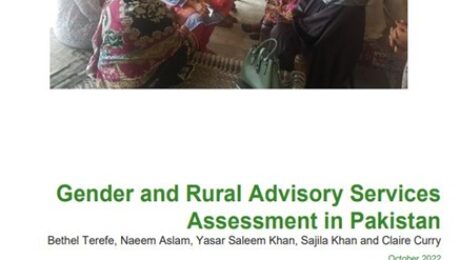
Women farmers in developing countries, including Pakistan, face challenges in accessing agriculture extension advisory services, with most of those services geared towards the needs of male farmers. Alongside other challenges faced by women farmers, this contributes to the gender gap in agriculture productivity in developing countries, whereby women-managed farms are 20–30% less productive than farms managed by men. It has been estimated that closing this gap would help to boost agriculture production by 2.5–4%, improve food security and improve the welfare of rural households (FAO, 2011).
In the context of the launch of CABI’s new PlantwisePlus programme in Pakistan, which aims to enhance the knowledge and uptake of climate-smart plant health practices through responsive digital advisory tools, this report presents the results of an assessment of the current state of gender-sensitive extension services in Pakistan, and provides recommendations for making improvements.
- Published in PAKISTAN
Gender differences in use and preferences of agricultural information sources in Pakistan
This study interviewed 401 male/female individuals in farm households in Jhang and Bahawalpur district of Punjab, Pakistan in 2016.
Findings: Men and women farmers’ use and preferences in accessing information sources are extremely different. Women hardly use sources for agricultural information, and value interpersonal communication from informal sources. In contrast, men use and value official agencies more. Radio, surprisingly, was very rarely used, contradicting previous findings of research elsewhere. Age and literacy affect differences between women more than it does between men, particularly for convenient locations to access information. Practical implications The study identified and refined major gender differences regarding use and preference for agricultural information in relation to age and literacy, and helps to articulate options to improve gender equality of access to agricultural information in Pakistan.
Theoretical implications: The focus and outcomes regarding gender intersecting with age and literacy in agricultural information access imply the need for more refined socio-economic models, discerning and interrelating gender and other social dimensions beyond the standard of male-headed households.
Originality/value: This paper adds to the growing body of evidence on information access according to gender, highlighting the need to investigate deeper socio-cultural issues around age and literacy.
- Published in PAKISTAN
Pakistan | 2021 Humanitarian Response Plan
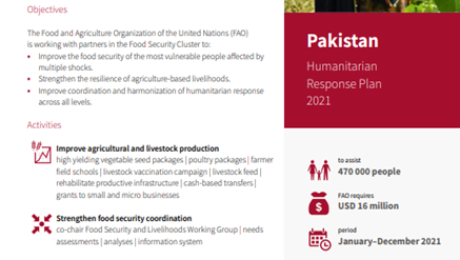
The food security situation in Pakistan has significantly worsened, mainly due to drought, floods, desert locust and conflict, which have triggered population displacements and reduced agricultural production.The number of people in need of food security and livelihoods assistance is projected to increase to over 6.1 million people in June 2021, making it critical to provide integrated agricultural support to vulnerable people devastated by multiple shocks.
- Published in PAKISTAN
Dysfunctional Horticulture Value Chains and the Need for Modern Marketing Infrastructure: The Case of Pakistan
This brief presents findings on agricultural wholesale markets in Pakistan and provides recommendations to help develop more efficient production and marketing systems.
The brief provides an overview of Pakistan’s agriculture sector and horticulture value chain, and of four agricultural wholesale markets in Lahore. It proposes ways of improving the management, maintenance, and accessibility of markets, and making the value chain more efficient.
- Published in PAKISTAN
Impact of COVID-19 and Locust Swarms on Farm Households in Sindh, Pakistan: Analysis of Data from a Cross-Sectional Survey
This brief identifies measures to mitigate the impact of the coronavirus disease (COVID-19) pandemic and locust infestation on farm households and the agriculture sector based on findings from a survey in Sindh, Pakistan.
An ADB survey conducted in June 2020 found that the lockdown due to COVID-19 significantly disrupted food supply chains across all major agricultural products in Sindh. Furthermore, severe locust invasions have been observed, with 73.7% of respondents having seen locust swarms in their area. The survey findings outline policy measures that can help farmers cope and adapt to the long-term consequences of the pandemic and locust swarms that affect farm households and agricultural produce.
National agrifood systems and COVID-19 in Pakistan
This report describes: (i) policy measures enacted by the Government of Pakistan to contain the spread of the virus; (ii) policies and measures to stabilize the functioning of agri-food systems; (iii) potential effects of policies on agri-food systems and vulnerable groups. Finally, the profile also assesses longer-term options for agri-food system policies and investments in Pakistan so as to make them more resilient.
2019 Forestry sector review: Pakistan
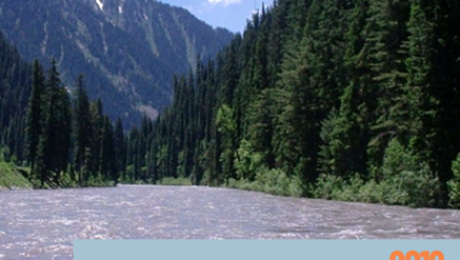
Pakistan is a federation of four provinces; Balochistan, Khyber Pakhtunkhwa (KP), Punjab and Sindh. The country has three special areas i.e. Federally Administered Tribal Area (FATA)1, Gilgit Baltistan (GB) and Islamabad Capital Territory (ICT). Pakistan is a forest poor country with a small area of 4.478 million ha (5.1 percent) under forests. This amounts to 0.021 ha per person, compared to the world average of 1 ha/person. The contribution of the forestry sector to the GNP and GDP as per official estimates seems quite insignificant, primarily due to the fact that a multitude of non-timber forest products (NTFP) and non-tangible environmental and ecological benefits of the forests are not taken into account. This review provides estimates of the total extent of forestry resources and identifies opportunities and hotspots while providing key recommendations for realizing a future sustainable forest system in Pakistan.Appropriate mechanisms and a well-defined strategy are required to address the numerous issues involved in sustainable forest management. The Review also highlights the involvement and contributions of local communities as an essential element for natural resource management and biodiversity conservation.
Statistical Capacity Country Profile for SDG Indicators (Pakistan)
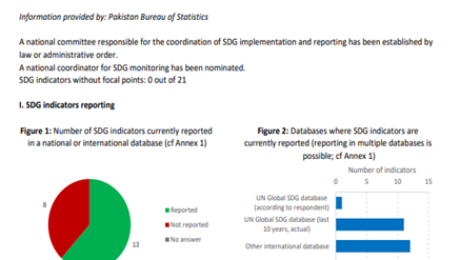
The Office of the Chief Statistician (OCS) conducted the Statistical Capacity Assessment for the FAO-relevant SDG indicators in early 2019 to provide insights about member countries’ national statistical systems in regard to their capacity to monitor and report the 21 SDG indicators under FAO custodianship. The survey collected information on the national coordination mechanisms for the SDG reporting, current data availability and plans for filling data gaps, and needs for technical assistance. The respondents were mainly the National Coordinators for SDG Monitoring or the SDG focal points nominated by the Directors General of National Statistics Offices. The results will assist FAO-HQ and decentralized offices in designing targeted interventions and mobilizing resources to support countries in collecting, analyzing and using the SDG indicators in decision-making.
Mountain agriculture: Opportunities for harnessing Zero Hunger in Asia
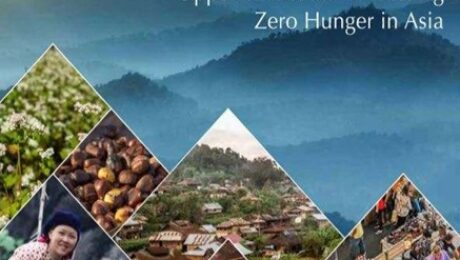
Mountain food security and nutrition are core issues that can contribute positively to the achievement of the Sustainable Development Goals but paradoxically are often ignored in Zero Hunger and poverty reduction-related agenda. Under the overall leadership of José Graziano da Silva, the Former Director-General of FAO, sustainable mountain agriculture development is set as a priority in Asia and the Pacific, to effectively address this issue and assist Member Countries in tackling food insecurity and malnutrition in mountain regions.
This comprehensive publication is the first of its kind that focuses on the multidimensional status, challenges, opportunities and solutions of sustainable mountain agriculture development for Zero Hunger in Asia. This publication is building on the ‘International Workshop and Regional Expert Consultation on Mountain Agriculture Development and Food Security and Nutrition Governance’, held by FAO RAP and UIR in November 2018 Beijing, in collaboration with partners from national governments, national agriculture institutes, universities, international organizations and international research institutes.
Remote sensing for space-time mapping of smog in Punjab and identification of the underlying causes using geographic information system (R-SMOG)
Food and Agriculture Organization of the United Nations, Pakistan initiated the Technical Cooperation Programme on Remote Sensing for Spatio-Temporal mapping of Smog (R-SMOG) upon the request of the Government of Punjab. The R-SMOG evaluates the relationship between Smog and the rice residue burning practices by farmers in the Rice belt of Punjab. It is a comprehensive geospatial research which integrates Spatio-temporal mapping of smog viz-a-viz climatological modelling, study of seasonal trends and dynamics and estimates an inventory of sectoral emissions. The findings of the R-SMOG will assist to generate scientific evidences to study the causes of Smog in Punjab and to adopt adequate mitigation and adaptation strategies.
- 1
- 2