
National catalogue of soybean varieties in Afghanistan
The national variety catalogue is an official document in which all commercialized crop varieties in the country are registered and their major varietal characteristics listed. It is a valuable reference for public- and private-sector plant breeders, seed producers, and crop producers, as well as seed certification agencies, extension services, and plant variety protection offices.
- Published in AFGHANISTAN, NUTRITION, RESOURCES
Nutrition Sensitive Food Systems in Conflict Affected Regions-A Case Study of Afghanistan
The food systems approach can contribute to food security and reduced malnutrition levels by identifying key investments and policies throughout the food system, including production, processing, marketing, and consumption of food. However, in countries facing fragility and conflict, it has proven difficult to implement such an approach and achieve the desired results. This has been the case in Afghanistan, where high levels of malnutrition stem in part from an undersupply of nutritious food. Multi-sectoral approaches to promote nutrition sensitivity and achieve diet-based solutions have also had only limited impact. This paper reports on an analysis of the nutrition sensitivity of food systems in Afghanistan using multi-sector consultations and gap analyses to examine two key food and nutrition policies, the National Comprehensive Agriculture Development Priority Program and the Afghanistan Food Security and Nutrition Agenda. It highlights gaps in the policies and identifies investment priorities to make food systems more nutrition sensitive. The results show that instilling nutrition sensitivity into the operation of Afghanistan’s food systems can only be accomplished if certain key measures are incorporated into the food system. These include addressing the absence of knowledge in the population regarding healthy diets, the lack of sufficient food for vulnerable populations, weak irrigation systems, capacity constraints at individual and institutional levels, data challenges, and weak natural resource management. In addition, the above weaknesses are compounded by the continued violence and conflict-induced insecurity, weak government, and inadequate investments. Given the role of different sectors in contributing to improved nutrition, appropriate and effective multistakeholder coordination and collaboration is paramount to such efforts.
- Published in AFGHANISTAN, NUTRITION, RESOURCES
Global Capacity Needs Assessment for Nutrition-Sensitive Agriculture

Building the capacities in nutrition of agricultural extension and advisory services (EAS) is widely considered a critical aspect to promote nutrition-sensitive agriculture (NSA) and help achieve household food and nutrition security. Under the auspices of the German-funded ‘Strengthening Capacities for Nutrition Sensitive Agriculture and Food Systems’ project (GCP/INT/714/GER), the Food and Agriculture Organization of the United Nations (FAO) in partnership with the Global Forum for Rural Advisory Services (GFRAS) initiated in 2019 a process to understand the gaps in learning and capacity among EAS providers in integrating nutrition objectives into agricultural extension programmes and policies. This process consisted of the development, the piloting at country level, the validation and dissemination of a Global Capacity Needs Assessment (GCNA) methodology aimed to assist countries in assessing their own capacity gaps in nutrition and EAS. The GCNA methodology was then pilot- tested in five countries in four regions by GFRAS member organizations. These assessments were led by the GFRAS Regional networks and Country Fora and consultants specifically associated with these networks. Country level workshops were carried out by GFRAS regional members to review the outputs of the pilot studies.
Consultative Workshop on Learning Needs Assessment for Nutrition Sensitive Agriculture in India

The Centre for Research on Innovation and Science Policy (CRISP) and Agricultural Extension South Asia Network (AESA), organised the Consultation workshop on ‘Learning Needs Assessment for Nutrition Sensitive Agriculture (NSA) in Telangana’ on 3 January 2020, at Hyderabad, Telangana, India. This workshop was organised to validate the findings of the study and the use of Global Learning Needs Assessment (GLNA) Methodology to assess learning needs. The participants included representatives from the government and non-governmental organisations engaged in research, teaching, training, extension, and programme implementation. Prior to the workshop, the draft report on the findings of the study was shared with the participants and each of them was apprised of the agenda.
Strengthening Seed Systems Promoting Community Based Seed Systems for Biodiversity Conservation and Food & Nutrition Security in South Asia
In this forum, the government representatives from SAARC Member States, experts, researchers, and farmers’ organizations were participated with innovative ideas and experience that contributed to come up with this Volume. Thus, we are delighted to publish this book, which would be useful to formulate policies on strengthening the seed systems in general, Community Based Seed Systems (CBSS) in particular, for biodiversity conservation, food security and nutrition in the South Asia region.
We would express our sincere gratitude to the SAARC Agriculture Center (SAC); the Asian Farmers’ Association (AFA); the Pakistan Agricultural Research Council (PARC); the SAARC Member States, particularly the Ministry of Foreign/ External Affairs and Ministry of Agriculture; SAARC Secretariat; National Focal Point Experts; and Farmers Organizations for their significant contributions. We appreciate to Dr. S. M. Bokhtiar, Director, SAARC Agriculture Center (SAC) and the SAC team; AFA team; and PARC team for their outstanding contributions.
Local government planning for community food systems
This publication introduces a new knowledge base for understanding food planning and governance processes and models in local governments of low- and middle-income countries, a valuable counterbalance to the prevailing literature and experience from high-income countries. It provides practical insights on the needs, challenges and opportunities in local food planning practice in three countries in Asia, Africa and Latin America and the Caribbean. Based on reported cases, this publication offers a broad guiding framework and a methodology for subnational government bodies.
Food Systems Profile – Nepal

This document, entitled Profile of Food Systems, presents in ten pages a summary of the main problems of Nepal’s food systems, and possible solutions to make them more sustainable and inclusive. The result of a systemic analysis and consultation of all stakeholders in the systems, it is part of an evaluation supported by the European Union, FAO and CIRAD in 50 countries.
- Published in MONITORING & EVALUATION, NEPAL, NUTRITION
Design and monitor nutrition-sensitive agriculture and food systems programmes
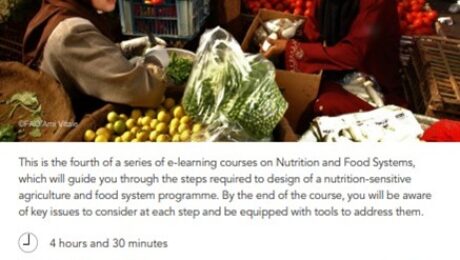
This fact sheet describes the fourth of a series of e-learning courses on Nutrition and Food Systems, which will guide you through the steps required to design of a nutrition-sensitive agriculture and food system programme. By the end of the course, you will be aware of key issues to consider at each step and be equipped with tools to address them.
- Published in MONITORING & EVALUATION, NUTRITION
Buy or make? Agricultural production diversity, markets and dietary diversity in Afghanistan
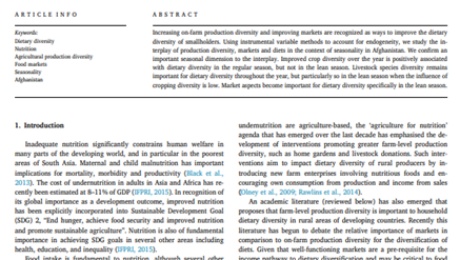
Increasing on-farm production diversity and improving markets are recognized as ways to improve the dietary diversity of smallholders. Using instrumental variable methods to account for endogeneity, we study the interplay of production diversity, markets and diets in the context of seasonality in Afghanistan. We confirm an important seasonal dimension to the interplay. Improved crop diversity over the year is positively associated with dietary diversity in the regular season, but not in the lean season. Livestock species diversity remains important for dietary diversity throughout the year, but particularly so in the lean season when the influence of cropping diversity is low. Market aspects become important for dietary diversity specifically in the lean season.
- Published in AFGHANISTAN, NUTRITION
Let the Youth Lead in Nutrition
The theme of the INO 2021 was “Let the Youth Lead in Nutrition” focusing the youth in the forefront to address malnutrition and aligned with the global mandates set in UN Food Systems Summit (UN FSS) and Nutrition for Growth (N4G) Summit 2021. A variety of engaging and interesting activities and discussion sessions were organised at INO 2021.
A Dhaka Declaration has been drafted based on the discussion and recommendations as an outcome of the Olympiad.