
Dysfunctional Horticulture Value Chains and the Need for Modern Marketing Infrastructure: The Case of Nepal
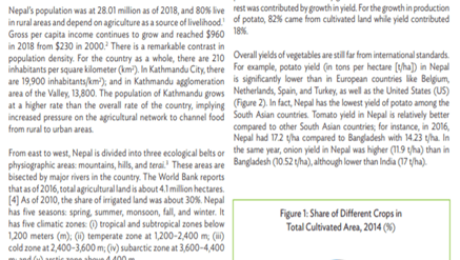
This brief provides an overview of Nepal’s agriculture sector and horticulture value chain, and of four agricultural wholesale markets. It notes that inefficiencies in the value chain lead to high seasonal and spatial price fluctuations for fruit and vegetables, and suggests ways of improving wholesale markets, production, and marketing.
- Published in NEPAL
Enhancing Rural Livelihoods in Underutilized/Abandoned Agricultural Land through Agroforestry
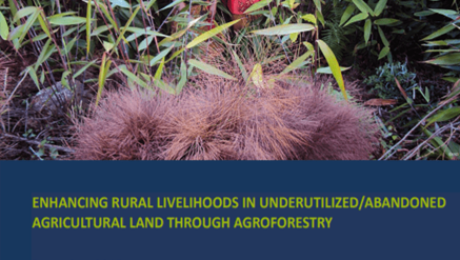
Nepal is facing an increasing problem of underutilization/abandonment of agricultural land In the context of food insecurity and poverty across rural communities, the growing current scale of abandonment of agricultural land has become one of the key development challenges in recent decades As a result of this trend, rural hill districts are currently experiencing food insecurity due to a lower rate of production and productivity per hectare This has created a challenge in terms of feeding a growing population In this context, the only way to address the problem of food insecurity is to increase agricultural production and the productivity of available land In order to address this emerging issue, as per the request and cooperation of the Government of Nepal, FAO and the International Union for Conservation of Nature ( implemented the pilot project, “Enhancing rural livelihoods in underutilized/abandoned agricultural land through agroforestry” with the objective of identifying and assessing approaches for implementation of so called “best bet” agroforestry options that have the potential to generate production and income from abandoned agricultural land.
- Published in NATURAL RESOURCE MANAGEMENT, NEPAL
Gender Equality and Social Inclusion
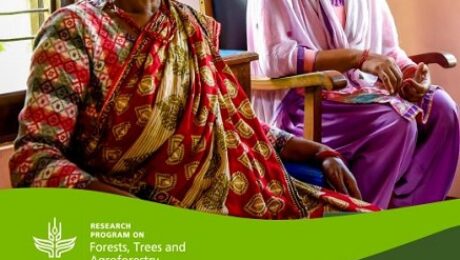
Both women and men depend on forests, agroforestry and trees for their livelihoods, and play a critical role in managing them. However, inequalities persist in roles, rights and responsibilities of women and men, and shape the ways they participate in decision making, benefit from forest and tree resources, and experience changes in forest and tree-based landscapes. Gender biases in the wider policy environment and exclusionary social norms result in a gender gap in access to and control of assets and key resources, including land, labor, credit, information and extension services, with women facing disadvantages in several domains. These inequalities, embedded in formal and informal institutions and structures, hinder the change needed to support the sustainable and equitable development solutions that FTA seeks to deliver.
As FTA’s research agenda has evolved since the program’s inception, so too has the program’s portfolio of gender and social inclusion research. This revised research agenda and action plan draws on a tradition of quality gender work within FTA centers and complements FTA’s original Gender Strategy (2013). It reflects the evolution of the program, including thematic and methodological developments in gender research and praxis, and increases the focus on the nexus of gender and generation (including youth issues), and efforts to make FTA’s research increasingly transformative.
Advances in fruit breeding in Nepal
Nepal has spent about six decades on fruit development and research in different species. Fruit breeding particularly local and exotic germplasm collection started after 1950s and has gained momentum after the formation of commodity programme in 1972 AD. Major researches in the past were focused on indigenous and exotic genotype collection, evaluation, selection, propagation protocol standardization and adoptive trials. Some good ground works have already been done in major fruits such as apple, pear, plum, persimmon, kiwifruit, citrus, litchi, guava, pomegranate, walnut, papaya, banana and mango. The major public institutions involved in fruit breeding are Nepal Agricultural Research Council (NARC) following Agriculture and Forestry University. Some of the private nurseries like Everything Organic Nursery, Kavre and Technology Demonstration Centre of ICIMOD, Lalitpur were also involved in introduction and maintenance of indigenous and exotic fruit species. National Centre for Fruit Development, Kirtipur; Tropical Region Horticulture Centre, Nawalpur; Temperate Horticulture Farm, Satbanj, and Horticulture Farm, Marpha collected many local and exotic fruits and maintained at field gene bank. Horticulture Research Station, Rajikot has introduced 25 spur type apple cultivars and maintained in field gene bank. National Citrus Research Programme, Paripatle has introduced, collected and maintained 130 genotypes including exotic and indigenous landraces of citrus. Two varieties of acid lime ‘Sunkagati-1’ and ‘Sunkagati-2’ have been released and one variety ‘Terhathum Local’ has been registered. ‘Khoku Selection’ of mandarin orange has also been registered. Banana varieties ‘Malbhog’, ‘Willium Hybrid’ and ‘G9’ has been selected by participatory varietal selection and registered. To strengthen fruit breeding in the nation, NARC needs to be restructured with special focus on fruit researches. Establishment of national fruit commodity programs along with establishment of Tropical Fruit Research Station in Province 2 and Temperate Fruit Research Station in Province 5 at national level can streamline NARC’s fruit breeding researches.
- Published in EXTENSION AND INNOVATION, NEPAL
Transformation as system innovation: insights from Nepal’s five decades of community forestry development

Studies of sustainability transitions and transformational change are common in energy and transport sectors. However, there is limited research on how these transformational change processes play out in the natural resources sector, particularly in developing economies. This paper seeks to address this gap, with a case study of the community forestry system in Nepal that has, over the last four decades, reversed Himalayan land degradation and contributed to community livelihoods. The case illustrates comprehensive changes in forest management practices and governance over four decades. Central to this was a ‘thinking movement’ of development agencies, activists and researchers that opened up learning spaces and engage conflicting stakeholders in action-oriented dialogues. While transformation can never be pre-engineered, this study suggests that investment in strengthening locally engaged research capability could be a key way of catalyzing sustainability transitions, both as a continuous process of evolution and transformative shifts during the crisis and political opportunity.
- Published in EXTENSION AND INNOVATION, NEPAL
State of Social Inclusion in Nepal
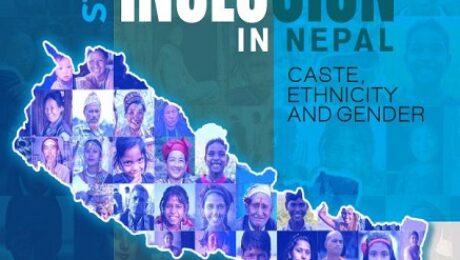
this background, the Central Department of Anthropology (CDA) at Tribhuvan University undertook this study on the “State of Social Inclusion in Nepal (SOSIN).” The study aims to produce a nuanced understanding of the situation and dynamics of social inclusion and gender equality. Using both quantitative surveys and qualitative assessments, this research generates empirical data about the current state of equality and social inclusion in Nepal and allows for the tracking of progress. This research is a sequel to the research project “Social Inclusion Atlas and Ethnographic Profile (SIA-EP)” implemented by the then joint Department of Sociology/Anthropology at TU in 2012-2014 with support from the Norwegian Embassy in Nepal. The SIA-EP established a comprehensive national database disaggregated by gender, caste and ethnicity, built a Multidimensional Social Inclusion Index through re-analysis of major national surveys, and produced profiles of 42 highly marginalized caste/ethnic groups to understand the micro-dynamics of exclusion.
- Published in EXTENSION AND INNOVATION, NEPAL
- 1
- 2