
Monitoring and evaluation of child labour in agriculture
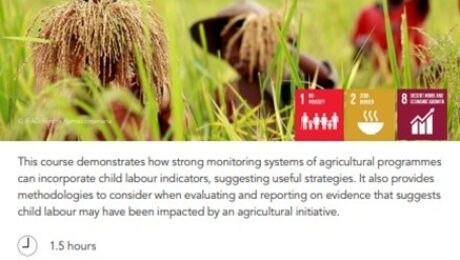
This fact sheet describes the course that demonstrates how strong monitoring systems of agricultural programmes can incorporate child labour indicators, suggesting useful strategies. It also provides methodologies to consider when evaluating and reporting on evidence that suggests child labour may have been impacted by an agricultural initiative.
- Published in MONITORING & EVALUATION
Mid-term evaluation of the project “Monitoring water productivity
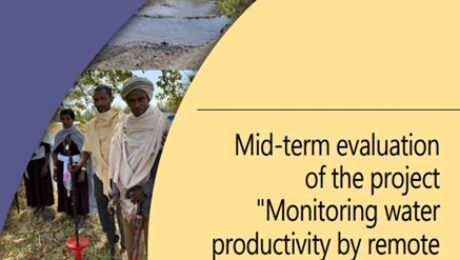
While population growth and economic development are putting unprecedented pressure on renewable, but finite water resources, especially in arid regions, scarce land and water resources are affecting food security and sustainable water management. FAO identified the need to implement a digital database built upon remote sensing and information technologies that can monitor and report on agricultural water productivity over Africa and Near East, accessible through the FAO Water Productivity through Open access of Remotely sensed derived data portal (WaPOR). The WaPOR database is now operational at continental level (all African and Near East countries covered by the 250 m spatial resolution data), national level (two beneficiary countries can access the WaPOR database at 100 m resolution) and subnational level with a spatial resolution of about 30 m, so far including eight areas of interest (river basins or irrigation schemes). Water Accounting Plus (WA+) reports based on remote sensing have been completed for three river basins as planned (Litani in Lebanon, Awash in Ethiopia and Jordan basin). An action framework at national level for capacity building and participatory decision making is currently being developed to make effective a “demand-driven” approach based on national and local needs.
- Published in MONITORING & EVALUATION
Indicator Framework for National Extension and Advisory Service Systems Metrics for performance and outcome measurement FAO (2022)
Extension and advisory services (EAS) play a key role in facilitating innovation for sustainable agricultural development. To strengthen this role, appropriate investment and conducive policies are needed in EAS, guided by evidence. It is therefore essential to examine EAS characteristics and performance in the context of modern, pluralistic and increasingly digital EAS systems. In response to this need, the Food and Agriculture Organization of the United Nations (FAO) has developed guidelines and instruments for the systematic assessment of national EAS systems. The Indicator Framework provides overarching guidance on EAS systems assessment, including a list of 40 indicators (10 core and 30 complementary) which cover all major aspects of EAS from inputs to impact. This Indicator Framework provides much needed structure to EAS assessment, taking into account contemporary, pluralistic services and is complemented by FAO’s instruments for participatory data collection in EAS, including quantitative and qualitative data.
- Published in GUIDE/TOOLS/MANUALS, MONITORING & EVALUATION