
Women and Men in Small-scale Fisheriers and Aquaclture in Asia
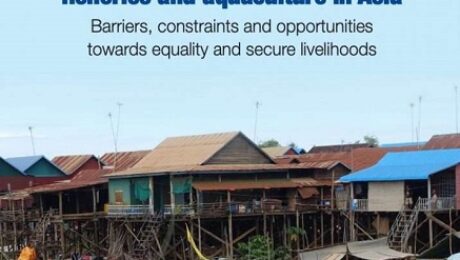
This study aims to consolidate the efforts to date to provide recommendations for action and future studies. Its objective is to answer the following questions for small-scale fisheries and aquaculture in Asia: (i) What is the division of labour between women and men in specific fisheries and aquaculture practices and what are the differences with respect to their access to assets, resources and entitlements? (ii) What are the drivers of such differences? (iii) What could be critical entry points and opportunities for addressing inequalities and discriminatory practices? To answer these questions, the study conducted an online literature search on gender and fisheries and aquaculture in Asia, selecting articles published between 2011 and 2021.
- Published in GENDER, ICTs, LIVESTOCK / FISHERIES, RESOURCES
Promoting the Development of Livestock Value Chains in Bangladesh to Reduce Poverty
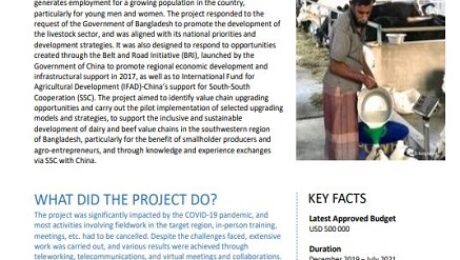
Bangladesh is a low income economy. The livestock sector is not only a source of income and nutritious food for rural households, it also generates employment for a growing population in the country, particularly for young men and women. The project responded to the request of the Government of Bangladesh to promote the development of the livestock sector, and was aligned with its national priorities and development strategies. It was also designed to respond to opportunities created through the Belt and Road Initiative (BRI), launched by the Government of China to promote regional economic development and infrastructural support in 2017, as well as to International Fund for Agricultural Development (IFAD) China’s support for South South Cooperation (SSC). The project aimed to identify value chain upgrading opportunities and carry out the pilot implementation of selected upgrading models and strategies, to support the inclusive and sustainable development of dairy and beef value chains in the southwestern region of Bangladesh, particularly for the benefit of smallholder producers and agro entrepreneurs, and through knowledge and experience exchanges via SSC with China.
- Published in LIVESTOCK / FISHERIES, RESOURCES
Emergency guidelines and standards for livestock in Pakistan
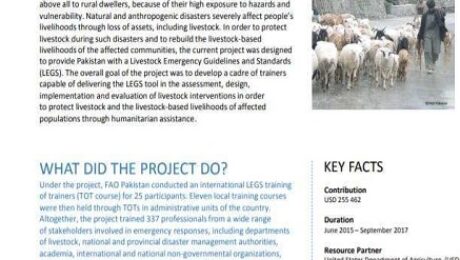
Around 62 percent of Pakistan’s population lives in rural areas, which are highly susceptible to natural disasters. Resource-poor rural households possess relatively high financial assets in the form of livestock and are largely dependent on animals for their food security and livelihoods. The impacts of disaster are extremely detrimental to the population, above all to rural dwellers, because of their high exposure to hazards and vulnerability. Natural and anthropogenic disasters severely affect people’s livelihoods through loss of assets, including livestock. In order to protect livestock during such disasters and to rebuild the livestock-based livelihoods of the affected communities, the current project was designed to provide Pakistan with a Livestock Emergency Guidelines and Standards (LEGS). The overall goal of the project was to develop a cadre of trainers capable of delivering the LEGS tool in the assessment, design, implementation and evaluation of livestock interventions in order to protect livestock and the livestock-based livelihoods of affected populations through humanitarian assistance.
- Published in LIVESTOCK / FISHERIES, PAKISTAN, RESOURCES
Republic of Maldives Post-Tsunami Agricultural and Fisheries Rehabilitation Programme
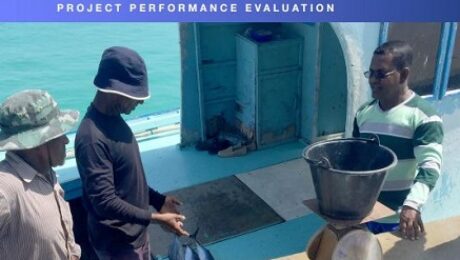
The programme could have been better revitalized with effective programme planning and a clear intervention logic. Although there was a wholesale set of changes in the components of the programme, there was no systematic reconsideration of the programme’s overall objectives. As a result, the programme was most effective at national policy level with regard to sustainable fishing, but it is rather difficult to measure any direct effect at ground level.
- Published in LIVESTOCK / FISHERIES, MALDIVES
Fisheries Sector and Development of Maldives: Can Vocational and Technical Education Help?
Global experience confirms that ‘family business concept’ was the domain in the establishment of fisheries sector. Apprenticeship of family inheritance was only the training provision available for the fishermen earlier. While fishermen used to receive a little amount of training through family apprenticeship, light of education to become a qualified citizen for modern world was unreachable to them. Things have incredibly or marginally been changed in a few countries where public policy took necessary parameters in order to institutionalize this sector aligning with the long term developmental vision and mission of the state. However, most of the countries still follow the orthodox model since professionals working with this sector are less capable to put forward their voices in the elite podium where public policy of a country is designed and constitutionalized. Maldives is country where more than 80% of the population are directly and indirectly or by hobby are involved with the fisheries sector providing a major local contribution towards Gross Domestic Product (GDP). Despite this contribution, the sector experiences significant amount of shortfalls. The purpose of this study is to map and identify those shortfalls in order to offer an elucidation.
- Published in LIVESTOCK / FISHERIES
A socio-economic Assessment of the tuna fisheries in the Maldives
This report presents an analysis of the role of the pole-and-line fishery of the Maldives as a social and economic policy, as opposed to a purely ecological one. The study explores how government policies have helped shape the fishery and have impacted on the vulnerability, adaptability and livelihood assets of the local population. The sector is heavily exposed to trends on the world market, and the economic potential of the fisheries remains underutilised. However, the pole-and-line fishery has served to create an accessible and equitable form of employment to a large, and otherwise isolated, part of the population, and benefits from the fishery are spread through the economy through consumer spending, saving and re-investment, including in education.
- Published in LIVESTOCK / FISHERIES
Shades of institutional change: the case of Nature Fresh dairy development project
This study reviewed the context, organisational arrangements and institutional changes for the operation of a smallholder dairy development project, comprising multi-stakeholders in three locales. The objective was to have a comparative assessment of the project dynamics and to draw lessons for improving its performance.
- Published in LIVESTOCK / FISHERIES
A review of major river basins and large lakes relevant to inland fisheries
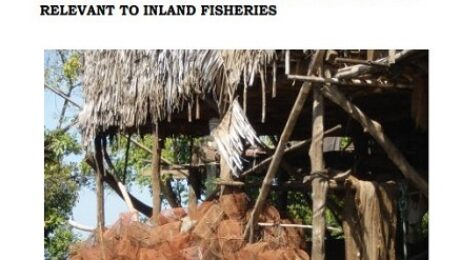
This review presents summary information on 45 river and great lake basins of the world, which support inland fisheries. The information presented is drawn from published information in peer-reviewed journals as well as grey literature. Each basin summary is presented in a common format, covering the description of the fishery, estimates of catch and numbers of people engaged in the fishery, important biodiversity features and threats to the fishery. An analysis of the replacement costs of inland fish of the basin is also presented. This is expressed in terms of the water, land and greenhouse gas footprint that would arise if the inland fish that are currently produced had to be replaced with other forms of food (such as aquaculture fish, livestock or field crops).
- Published in LIVESTOCK / FISHERIES
Addressing Feed Shortages through Exploration of Unconventional Feed Resources for Accelerated Livestock Development in Bangladesh
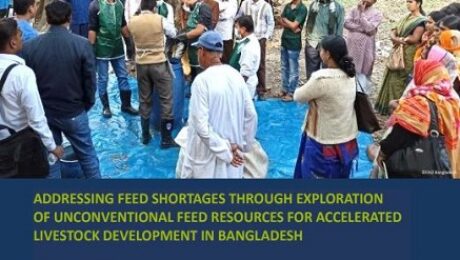
Growing demand for livestock products in Bangladesh offers attractive opportunities for strengthening household level food security, nutrition and rural livelihoods However, the sector’s ability to capitalize on these opportunities is constrained by poor productivity of animals at farm level Scarcity of feeds and fodder is one of the major constraints identified for cattle production in the country In addition to forage scarcity, the cost of feeding represents the largest expense (around 70 percent) in most livestock operations However, the country has many resources that can sustain ruminant livestock, such as agro industrial by products, on which ruminant livestock can survive In view of this, it was necessary to recognize the availability of these resources and use them skilfully Methods include physical, chemical and biological treatments of coarse material Against this background, the Government of Bangladesh requested that FAO provide assistance in the development of animal nutrition The project aimed to increase animal productivity and profitability for beneficiary farmers, leading to better health of animals and decreased costs in the treatment of animals.
- Published in BANGLADESH, LIVESTOCK / FISHERIES
The small livestock advantage: A sustainable entry point for addressing SDGs in rural areas
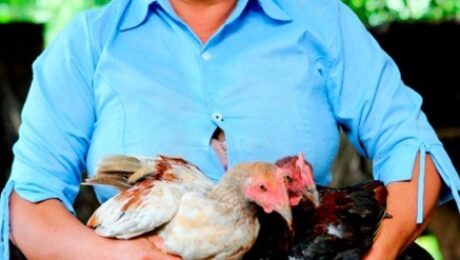
This report presents selected achievements and lessons learned from the growing portfolio of small livestock investments supported by IFAD.
There is no universal and unique definition of “small livestock”, but in the context of this publication, the following species have been considered: poultry, swine, small ruminants, guinea pigs, and rabbits.
The Introduction presents IFAD’s key messages on investing in small livestock development. The Case Studies section features a review of five relevant projects from IFAD’s portfolio (in Afghanistan, Lesotho, Nepal, Senegal and Venezuela) that provide concrete examples of how IFAD is working to support small-scale farmers. Lessons learned from IFAD’s support for this sector, and some potential ways forward, conclude the report.
- Published in LIVESTOCK / FISHERIES, POLICY
- 1
- 2