
Save Nature Please- A Behaviour Change Framework for Conservation

Bridging the disconnect between rational, fact-based decision-making and emotional or instinctive behaviour, behavioural science is helping civil society organizations, communities, governments, and corporations design strategies and approaches that unlock positive behaviour change, and encourage us to make choices for a carbon-neutral and nature-positive future.
Save Nature Please
To make the fundamentals of behavioural science as accessible as possible for organisations, teams and individuals seeking to drive positive change, WWF has produced a new practical framework, ‘SAVE NATURE PLEASE’, designed to support more effective interventions – from global communications and campaigns to citizen and community engagement.
In its essence, the framework proposes a three-step process – each comprising a flexible menu of subsidiary components – for applying behavioural science to the development, delivery, evaluation, and scaling of behaviour change.
- Published in GUIDE/TOOLS/MANUALS
Agricultural Extension Manual
Department of Agricultural Extension, Ministry of Agriculture
Government of the People’s Republic of Bangladesh
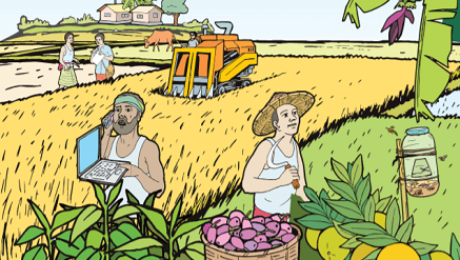
Agriculture has always been the main driving force behind Bengal’s heritage and socio-economic development. The energy from food, of life itself, of labour and intellect shares strong links and a single source of origin agriculture. More than 45% of the country’s labour force is involved with the agriculture sector. Therefore, the development of the country is dependent on the overall development of agriculture.
- Published in BANGLADESH, GUIDE/TOOLS/MANUALS
Conducting Tablet-Based Field Data Collection with Survey Solutions
This handbook has been developed to complement the MOOC on Survey Solutions. It is suitable for anyone who has experience in conducting traditional face-to-face interviews and wishes to learn the workflows and skills needed to conduct a CAPI project. The handbook’s instructions are tailored toward people with beginner or intermediate experience in Survey Solutions, particularly if they are looking to reinforce existing knowledge or learn additional functionalities. handbook is designed to help national statistical officers and other interested readers embrace the efficiencies of CAPI-based data collection to supersede the traditional pen and paper interviewing method. We hope that it contributes to the adoption of other innovative tools and technologies that further strengthen national statistical systems.
- Published in GUIDE/TOOLS/MANUALS, ICTs
The GSMA AgriTech Toolkit for the Digitisation of Agricultural Value Chains
The Toolkit for the Digitisation of Agricultural Value Chains is a collection of resources that illustrate how digital technologies can address pain points for farmers and value chain actors, such as agribusinesses and cooperatives, in the agricultural last mile. These resources support the use of digital technologies for digital procurement, by enabling the transition from paper to digital for a range of systems and processes in the last mile. The toolkit explains how digitising the last mile offers a pathway to financial inclusion for farmers.
The toolkit has been designed to be read either as a complete document from start to finish, or as individual chapters if one is working through a particular challenge. Although each chapter may be more relevant to specific audiences, readers would benefit from reading the report in its entirety.
- Published in GUIDE/TOOLS/MANUALS, ICTs, VALUE CHAIN / MARKETS
Asia and the Pacific SDG Progress Report 2020

Striking lack of progress on environmental SDGs in Asia-Pacific, reveals new UN report, There is overwhelming evidence that the Asia-Pacific region needs to accelerate action on the Sustainable Development Goals (SDGs) and substantially reverse current negative trends, especially those which are depleting and degrading its environmental resources, according to a new report released today by the United Nations Economic and Social Commission for Asia and the Pacific (ESCAP).
The Asia and the Pacific SDG Progress Report 2020 draws attention to the region’s poor performance on most of the measurable environmental targets of the 2030 Agenda for Sustainable Development. For example, the share of renewable energy has dropped to 16 per cent, one of the lowest rates globally. The region also emits half of the world’s total greenhouse gas – a number which has doubled since 2000. 35 per cent of countries continue to lose their forests.
- Published in GUIDE/TOOLS/MANUALS
A compendium of Technologies, Practices, Services and Policies for Scaling Climate Smart Agriculture in Odisha (India)
Stakeholders engaged in agricultural research for development (AR4D) are increasingly tackling risks associated with climate change in smallholder systems. Accordingly, development and scaling of climate-smart agriculture (CSA) are one of the priorities for all the organizations, departments and ministries associated with the farm sector. Having a ‘one-stop-shop’ compiled in the format of a compendium for CSA technologies, practices and services would therefore serve a guide for all the stakeholders for scaling CSA in smallholder systems.
- Published in GUIDE/TOOLS/MANUALS, INDIA
Indicator Framework for National Extension and Advisory Service Systems Metrics for performance and outcome measurement FAO (2022)
Extension and advisory services (EAS) play a key role in facilitating innovation for sustainable agricultural development. To strengthen this role, appropriate investment and conducive policies are needed in EAS, guided by evidence. It is therefore essential to examine EAS characteristics and performance in the context of modern, pluralistic and increasingly digital EAS systems. In response to this need, the Food and Agriculture Organization of the United Nations (FAO) has developed guidelines and instruments for the systematic assessment of national EAS systems. The Indicator Framework provides overarching guidance on EAS systems assessment, including a list of 40 indicators (10 core and 30 complementary) which cover all major aspects of EAS from inputs to impact. This Indicator Framework provides much needed structure to EAS assessment, taking into account contemporary, pluralistic services and is complemented by FAO’s instruments for participatory data collection in EAS, including quantitative and qualitative data.
- Published in GUIDE/TOOLS/MANUALS, MONITORING & EVALUATION
Common Framework on Capacity Development for Agricultural Innovation Systems | CONCEPTUAL BACKGROUND

The Tropical Agriculture Platform (TAP) is a G20 initiative with strategic goal of contributing to the development of national capacities for agricultural innovation in the tropics and the objective of enhancing “Capacity Development” (CD) in “Agricultural Innovation Systems” (AIS). As stated in the TAP “Theory of Change”, the “TAP capitalizes on and adds value to on-going initiatives by fostering greater coherence of capacity development interventions in tropical agriculture, strengthening interaction for more harmonized action and greater mutual accountability, and avoiding duplication”.
One of the first tasks of TAP is therefore to facilitate the emergence of a common language and a shared understanding of the scope of the challenge. Most countries and Development Partners (DP) use their own terminology and a lot of time is lost in trying to understand the exact meaning of the words used. A few examples: Are “capacity development”, “capacity strengthening” and “capacity building” synonymous? What is meant by “Agricultural Innovation Systems” (AIS)? Is there a general agreement on the three “levels” usually identified in the field of capacity development” (CD), i.e. individual, organisational and institutional/system? How are defined the CD recipients/targets for each of these levels?
- Published in EXTENSION AND INNOVATION, GUIDE/TOOLS/MANUALS
Common Framework on Capacity Development for Agricultural Innovation Systems | GUIDANCE NOTE ON OPERATIONALIZATION
Agricultural innovation is critical for increasing agricultural productivity as well as for sustainability of agricultural systems. Innovation, however, cannot rely solely on spin-offs from foreign research. It requires endogenous capacities to generate, systematize, and adapt knowledge as well as to adopt and up-scale new practices.
An Agricultural Innovation System (AIS) is a network of actors or organizations, and individuals, together with supporting institutions and policies in the agricultural and related sectors, which bring existing or new products, processes, and forms of organization into social and economic use. Policies and institutions (formal and informal) shape the way that these actors interact, generate, share and use knowledge as well as jointly learn.
Capacity Development for Agricultural Innovation Systems (CD for AIS) enables joint learning and co-creation and new uses of knowledge for social change and enhances the interactions between actors. It is also about creating an enabling environment for such interaction, learning and innovation, based not only on conducive formal law and regulations, but also on informal values, attitudes and behaviours. It aims at changing people’s behaviour and developing of more sustainable practices that bring about societal transformation.
- Published in EXTENSION AND INNOVATION, GUIDE/TOOLS/MANUALS
Common Framework on Capacity Development for Agricultural Innovation Systems

Innovation in agriculture is a precondition for meeting the challenge of feeding the world’s growing population in the face of a changing climate and degrading natural resources. It is fundamental to achieving the Sustainable Development Goals of ending poverty and hunger, achieving food security, improving nutrition and promoting sustainable agriculture. Innovation also has a role to play in achieving gender equality, ensuring healthy lives for all and contributing to economic growth. Many countries are however not fully exploiting their innovation potential. In order to do so, they must strengthen the capacity of individuals and organizations, create an enabling environment and, crucially, reinforced or make more effective Agricultural Innovation Systems (AIS).
AIS, may be defined as complex networks of actors (individuals, organizations and enterprises), together with supporting institutions and policies that bring existing or new agricultural products, processes, and practices into social and economic use.
In 2012, the Agriculture Ministers of the G20 called for the creation of a Tropical Agriculture Platform (TAP) to promote the development of national capacities for agricultural innovation in the tropics, where almost all low-income countries are located. The aim of TAP is to enhance the overall performance of AIS, with particular focus on small- and medium-scale producers and enterprises in the agribusiness sector. TAP’s ultimate objective is to make agriculture more sustainable and improve livelihoods.
- Published in EXTENSION AND INNOVATION, GUIDE/TOOLS/MANUALS