
Promoting the Development of Livestock Value Chains in Bangladesh to Reduce Poverty
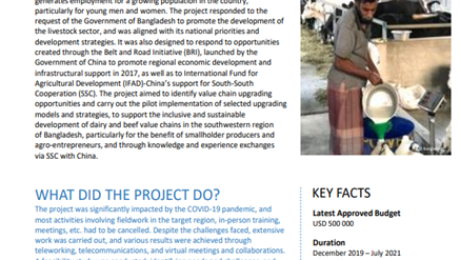
Bangladesh is a low income economy. The livestock sector is not only a source of income and nutritious food for rural households, it also generates employment for a growing population in the country, particularly for young men and women. The project responded to the request of the Government of Bangladesh to promote the development of the livestock sector, and was aligned with its national priorities and development strategies. It was also designed to respond to opportunities created through the Belt and Road Initiative (BRI), launched by the Government of China to promote regional economic development and infrastructural support in 2017, as well as to International Fund for Agricultural Development (IFAD) China’s support for South South Cooperation (SSC). The project aimed to identify value chain upgrading opportunities and carry out the pilot implementation of selected upgrading models and strategies, to support the inclusive and sustainable development of dairy and beef value chains in the southwestern region of Bangladesh, particularly for the benefit of smallholder producers and agro entrepreneurs, and through knowledge and experience exchanges via SSC with China.
- Published in BANGLADESH, NUTRITION, RESOURCES
Securing food for all in Bangladesh
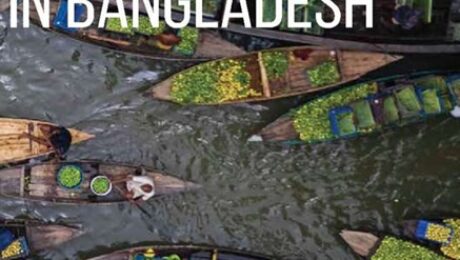
Access to sufficient food by all people at all times to meet their dietary needs is a matter of critical importance. Despite declining arable agricultural land, Bangladesh has made commendable progress in boosting domestic food production. The growth in overall food production has been keeping ahead of population growth, resulting in higher per capita availability of food over time. In the early 1970s, Bangladesh was a food-deficit country with a population of about 75 million. Today, the population is 165 million, and the country is now self-sufficient in rice production, which has tripled over the past three decades. Along with enhanced food production, increased income has improved people’s access to food. Furthermore, nutritional outcomes have improved significantly.
Nevertheless, the challenges to food and nutrition security remain formidable. Future agricultural growth and food and nutrition security are threatened by population growth, worsening soil fertility, diminishing access to land and other scarce natural resources, increasing vulnerability of crop varieties to pests and diseases, and persistent poverty leading to poor access to food. In addition, the impacts of climate change—an increase in the incidence of natural disasters, sea intrusion, and salinity—will exacerbate food and nutrition insecurity in the coming decades if corrective measures are not taken. Aligned with this context, the authors of the book explore policy options and strategies for developing agriculture and improving food security in Bangladesh. Securing Food for All in Bangladesh, with its breadth and scope, will be an invaluable resource for policymakers, researchers, and students dedicated to improving people’s livelihoods in Bangladesh.
- Published in BANGLADESH, NUTRITION, RESOURCES
New land, new life: a success story of new land resettlement in Bangladesh.
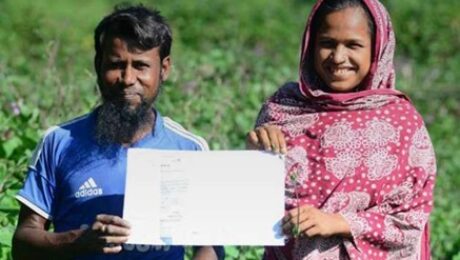
The Ganges-Brahmaputra-Meghna deltas has newly emerged ‘char’ islands, which are very vulnerable, socially, institutionally and environmentally. This book explains how the governments of Bangladesh and the Netherlands cooperated on a land-based rural development project to give settlers security and purpose. The 13 chapters in this book are based on experience gathered from implementing the Char Development and Settlement Project undertaken since 1994.
- Published in BANGLADESH
ACIAR–Bangladesh Collaboration Strategy 2021–2030
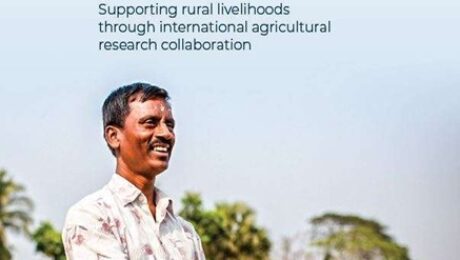
A 10-year strategy enables the possibility of longer-term and flexible programs that respond to the complex challenges of issues (such as climate change) and enables a recalibration of the relationship that can affirm the changing nature of the partnerships and the role ACIAR plays in catalysing regional collaboration. This strategy acknowledges how the relationship between ACIAR and Bangladesh has evolved to become a strong co-invested partnership, and affirms the importance of the contribution of ACIAR to regional collaboration.
- Published in BANGLADESH, PRIVATE SECTOR EXTENSION /PPP, RESOURCES
Women’s empowerment and farmland allocations in Bangladesh: evidence of a possible pathway to crop diversification
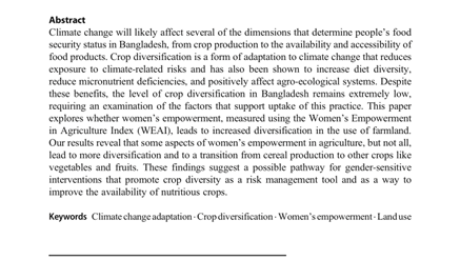
Climate change will likely affect several of the dimensions that determine people’s food security status in Bangladesh, from crop production to the availability and accessibility of food products. Crop diversification is a form of adaptation to climate change that reduces exposure to climate-related risks and has also been shown to increase diet diversity, reduce micronutrient deficiencies, and positively affect agro-ecological systems. Despite these benefits, the level of crop diversification in Bangladesh remains extremely low, requiring an examination of the factors that support uptake of this practice. This paper explores whether women’s empowerment, measured using the Women’s Empowerment in Agriculture Index (WEAI), leads to increased diversification in the use of farmland. Our results reveal that some aspects of women’s empowerment in agriculture, but not all, lead to more diversification and to a transition from cereal production to other crops like vegetables and fruits. These findings suggest a possible pathway for gender-sensitive interventions that promote crop diversity as a risk management tool and as a way to improve the availability of nutritious crops.
- Published in BANGLADESH, GENDER, RESOURCES
Development of balanced nutrient management innovations in South Asia: Perspectives from Bangladesh, India, Nepal, and Sri Lanka

Imbalanced application of fertilizers is a major fiscal and environmental problem in South Asia. We review fertilizer policies and extension efforts to promote the balanced application of nutrients in Bangladesh, India, Nepal, and Sri Lanka and draw 4 important lessons. (1) Fertilizer sector reforms need to be fiscally sustainable and politically feasible. Governments in South Asia have abolished fertilizer subsidies on multiple occasions, only to restore them a few years later. (2) The use of phosphate and potash did not decline much even after a sharp increase in their prices in India in 2011–12. Therefore, rationalizing subsidies, while necessary, may not be sufficient to ensure balanced use of fertilizers. Changing farmers’ practice requires combining the right incentives with the right information. (3) Soil test based soil health cards (SHC) hold promise, but there is limited evidence on their utility. India’s SHC program had very little impact on fertilizer use. (4) Direct cash transfer (DCT) of fertilizer subsidies can reduce distortions, but Sri Lanka’s experience shows that implementing it is more challenging than universal subsidies. DCT requires the removal of price controls, integration of land records, farmer identity cards, a cash transfer system with universal coverage, and a competitive fertilizer retail sector.
- Published in BANGLADESH, INDIA, NATURAL RESOURCE MANAGEMENT, NEPAL, RESOURCES, SRI LANKA
Addressing Feed Shortages through Exploration of Unconventional Feed Resources for Accelerated Livestock Development in Bangladesh
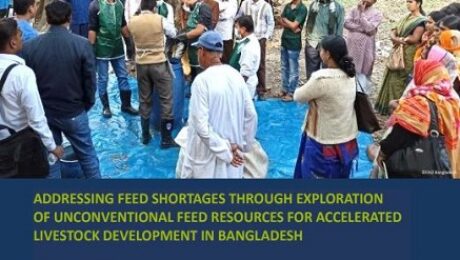
Growing demand for livestock products in Bangladesh offers attractive opportunities for strengthening household level food security, nutrition and rural livelihoods However, the sector’s ability to capitalize on these opportunities is constrained by poor productivity of animals at farm level Scarcity of feeds and fodder is one of the major constraints identified for cattle production in the country In addition to forage scarcity, the cost of feeding represents the largest expense (around 70 percent) in most livestock operations However, the country has many resources that can sustain ruminant livestock, such as agro industrial by products, on which ruminant livestock can survive In view of this, it was necessary to recognize the availability of these resources and use them skilfully Methods include physical, chemical and biological treatments of coarse material Against this background, the Government of Bangladesh requested that FAO provide assistance in the development of animal nutrition The project aimed to increase animal productivity and profitability for beneficiary farmers, leading to better health of animals and decreased costs in the treatment of animals.
- Published in BANGLADESH, LIVESTOCK / FISHERIES
Family Farmers’ Cooperatives: Ending Poverty and Hunger in South Asia
Family farming is an integrated farming system, which produces diverse agricultural commodities that significantly contribute to improve food and nutrition security and income of the poor and marginalized group of people in the rural areas. As the reduced level of the economies of scale is a major challenge encountered by family farmers in the South Asia that could be addressed by farmers’ cooperatives approach. Strengthening the farmers’ cooperatives would increase the economies of scale that reduce the cost per unit in production and marketing of the products, and eventually support to improve food security, increase income and reduce poverty. This paper is based on the secondary data and literature review. Ending poverty and hunger targets of the Sustainable Development Goals (SDGs) by 2030 is possible through strengthening the family farmers’ cooperatives in South Asia by adopting some major policy interventions. Such interventions include: i) Effective implementation of the South Asia regional plan of action of UN Decade of Family Farming (UNDFF); ii) Increase the public and private investment in family farming and farmers’ cooperatives; iii) Emphasize the multidimensional approach of program implementation to the poor and marginalized people; iv) Promotion of Future Smart Food System such as nutrition sensitive agriculture and the utilization of neglected and underutilized nutrition rich crops; and v) Effective coordination and cooperation among different agencies at the country level (local, sub-national, and national levels), development partners, South-South counties, and North-South countries to contribute in attaining the targets of Sustainable Development Goals, particularly the No Poverty and Zero Hunger through farmers’ cooperatives in South Asia.
- Published in BANGLADESH, BHUTAN, INDIA, MALDIVES, NEPAL, PAKISTAN, PRODUCER ORGANISATION, SRI LANKA
Agricultural Extension Manual
Department of Agricultural Extension, Ministry of Agriculture
Government of the People’s Republic of Bangladesh
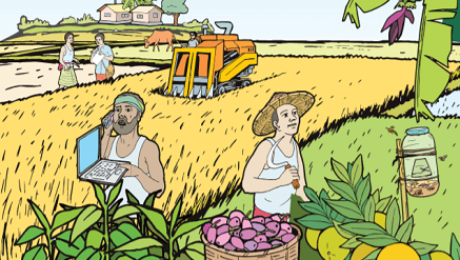
Agriculture has always been the main driving force behind Bengal’s heritage and socio-economic development. The energy from food, of life itself, of labour and intellect shares strong links and a single source of origin agriculture. More than 45% of the country’s labour force is involved with the agriculture sector. Therefore, the development of the country is dependent on the overall development of agriculture.
- Published in BANGLADESH, GUIDE/TOOLS/MANUALS
Conservation tillage (CT) for climate-smart sustainable intensification

Soil organic carbon (SOC), greenhouse gas (GHG) emissions and water footprint (WF) are the key indicators of environmental sustainability in agricultural systems. Increasing soil organic carbon (SOC) while reducing water footprint (WF) and GHG emissions are effective measures to achieve high crop productivity with minimum environmental impact (i.e. a multi-pronged approach of sustainable intensification (SI) and climate smart agriculture (CSA) to achieve food security). In conventional agricultural systems, intensive soil tillage and removal of crop residues can lead to increased negative environmental impact due to reduced SOC, GHG emission and high water consumption. Conservation agriculture (CA) based conservation tillage systems (CTS) with crop residue retention is often suggested as a sustainable alternative to increase crop productivity without compromising soil health and environmental sustainability. The environmental impact of CTS in terms of SOC, WF and GHG emissions nonetheless remains understudied In Bangladesh. A two-year field experiment was carried out to evaluate the impacts of CTS with retention of crop residue on SOC accumulation, GHG emission and water footprint (WF) in wheat farming of Bangladesh. In the experiment, CTS such as zero tillage (ZT) and minimum tillage (MT) were compared with the conventional tillage (CT) practice. Since the results are in favor of CTS, this study recommends MT and ZT to reduce negative environmental externalities in wheat cultivation in Bangladesh. In comparison between the methods, the MT, which retains crop residue (20 cm), and involves principles of CA, is suitable for both CSA and SI of wheat in Bangladesh due to its ability to increase SOC accumulation, prevent both water loss, and GHG emission without compromising yield.
- Published in AGROECOLOGY, BANGLADESH, CLIMATE CHANGE
- 1
- 2