
Operational guide on agroecology
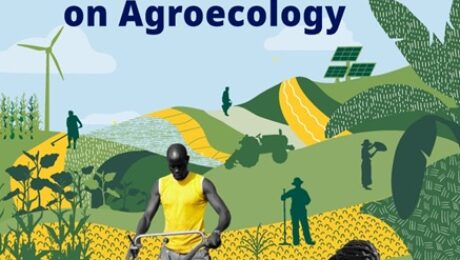
Agroecology is a polysemic concept whose contours have evolved over almost a century. There is not a single definition but a large number that reflect the concerns and commitments of the different authors and practitioners. Thus, the scientific and technical perspective adopted by the High Level Panel of Experts (HLPE) in 2016 when it described agroecology as ‘the application of ecological concepts and principles to agricultural systems, focusing on the interactions between plants, animals, humans and the environment, to foster sustainable agricultural development in order to ensure food and nutrition security for all today and tomorrow’ has become too restrictive. Indeed, the concept has become more complex as it addresses agri-food systems as a whole, and not just agricultural systems, by overcoming the divide between the scientific and technical dimensions of agroecology and its social and political dimensions, and by adopting a holistic perspective. The resulting concept of agroecology, which is widely shared today, is that of a transdisciplinary, participatory and action-oriented approach, relating at the same time to a transdisciplinary science, a set of practices and a social movement.
- Published in AGROECOLOGY
Smart Agricultural Technology

Agriculture is undergoing a rapid digital transformation that challenges its ecological, social, and ethical foundations. A total of 136 documents were analysed through bibliometric and thematic synthesis. Results show that A5.0 represents a philosophical and structural evolution beyond the efficiency-oriented logic of A4.0, integrating distributed computing, explainable artificial intelligence, digital twins, and collaborative robotics within ecologically restorative and socially inclusive frameworks. However, while A5.0 strengthens resource efficiency, resilience, and certain social segments through open-source technologies and participatory design, gaps remain in policy coherence, emotional engagement, and human–machine co-learning. To address these, the study proposes two complementary agroecological principles, cognitive symbiosis and emotional ecology, emphasising shared intelligence and affective stewardship between humans, machines, and ecosystems. Overall, Agriculture 5.0 reframes digitalisation as a human-ecological partnership that can operationalise agroecology’s ethical goals if governed by inclusion, transparency, and regeneration rather than control and optimisation.
- Published in AGROECOLOGY, NEW PUBLICATIONS
Guide for the evaluation of agroecology

The “Guide for the Evaluation of Agroecology” published in 2025 is a comprehensive manual that provides a standardized methodology to assess the real-world agro-environmental and socio-economic impacts of agroecological practices. It offers practical tools to help farmers, practitioners, researchers, and policymakers to generate reliable data on critical aspects. This invaluable resource is designed to build a robust evidence base, supporting the effective design and scaling of sustainable agricultural systems.
- Published in AGROECOLOGY, MONITORING & EVALUATION
Conservation tillage (CT) for climate-smart sustainable intensification

Soil organic carbon (SOC), greenhouse gas (GHG) emissions and water footprint (WF) are the key indicators of environmental sustainability in agricultural systems. Increasing soil organic carbon (SOC) while reducing water footprint (WF) and GHG emissions are effective measures to achieve high crop productivity with minimum environmental impact (i.e. a multi-pronged approach of sustainable intensification (SI) and climate smart agriculture (CSA) to achieve food security). In conventional agricultural systems, intensive soil tillage and removal of crop residues can lead to increased negative environmental impact due to reduced SOC, GHG emission and high water consumption. Conservation agriculture (CA) based conservation tillage systems (CTS) with crop residue retention is often suggested as a sustainable alternative to increase crop productivity without compromising soil health and environmental sustainability. The environmental impact of CTS in terms of SOC, WF and GHG emissions nonetheless remains understudied In Bangladesh. A two-year field experiment was carried out to evaluate the impacts of CTS with retention of crop residue on SOC accumulation, GHG emission and water footprint (WF) in wheat farming of Bangladesh. In the experiment, CTS such as zero tillage (ZT) and minimum tillage (MT) were compared with the conventional tillage (CT) practice. Since the results are in favor of CTS, this study recommends MT and ZT to reduce negative environmental externalities in wheat cultivation in Bangladesh. In comparison between the methods, the MT, which retains crop residue (20 cm), and involves principles of CA, is suitable for both CSA and SI of wheat in Bangladesh due to its ability to increase SOC accumulation, prevent both water loss, and GHG emission without compromising yield.
- Published in AGROECOLOGY, BANGLADESH, CLIMATE CHANGE
Re-thinking food systems in Andhra Pradesh, India | How Natural Farming could feed the future
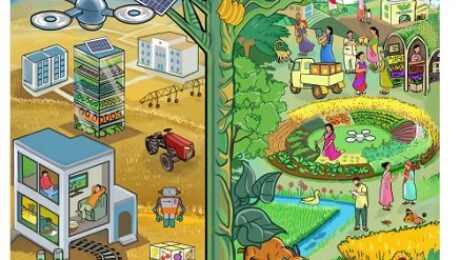
Food systems provide a wider lens, addressing the connections between food, health, employment, incomes, environment and the well-being of human communities.
Led by the Government of Andhra Pradesh, CIRAD and FAO, AgroEco2050 is a collective future-building exercise engaging scientists, farmers, policymakers and institutions.
It unveils hidden realities, processes, actors and parameters to explore broader visions for sustainable food systems by 2050.
It builds on a huge diversity of data and knowledge to help democratic societies shape the futures they desire, rather than predicting or prescribing it.
AgroEco2050 aimed to clarify and quantify two different visions of what agriculture, food, nature, jobs and welfare in Andhra Pradesh might look like in 2050. One vision was based on the intensification of conventional industrial farming, while the other was based on taking natural farming (agroecology) to scale. The goal was to compare and understand the implications of these two different pathways and verify their coherence.
- Published in AGROECOLOGY
Methodological recommendations to better evaluate the effects of farmer field schools mobilized to support agroecological transitions
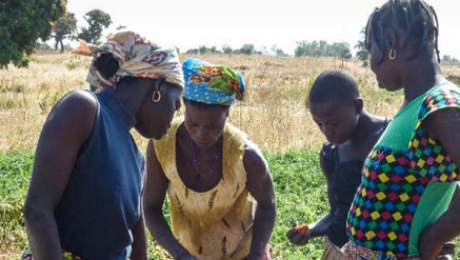
The farmer field school (FFS) approach, based on group experimentation of innovative practices and/or farming systems, is in line with participatory farm advisory efforts. This approach has an ambitious goal: strengthening farmers’ skills so that they can adapt their practices, or even invent new ones, and move towards more agroecological farming systems. Assessing such an advisory intervention poses significant challenges. The purpose of this document is to propose fresh ways to update FFS assessment methods, notably the study of changes in farming practices and the detailed analysis of FFS outcomes. Project designers, managers, and evaluators are the target audience for this document, which may also interest teachers, researchers, students, and policymakers. The elements of the FFS assessment methodology presented here stem from the collaboration between three institutions, CIRAD, FAO (Food and Agriculture Organization of the United Nations), and the NGO AVSF (Agronomists and Veterinarians Without Borders), and fieldwork carried out in cotton-growing areas of Burkina Faso and Togo between 2018 and 2019.
This document is divided into four parts. We first define FSS and the principles of the approach, then we detail the methods commonly used to assess FSS and the challenges involved. We then present a comprehensive assessment method using a case study in northern Togo. The final part of the report provides a basis for placing the proposed method within the process of designing an assessment for a project involving FSS.
- Published in AGROECOLOGY
Agroecology: a holistic path towards sustainable food systems
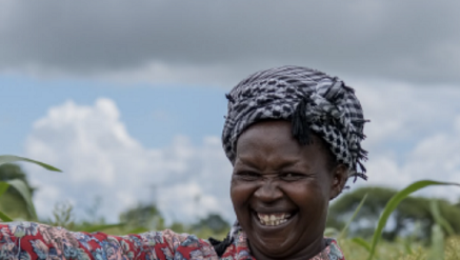
Agroecology applies ecological principles to agriculture and ensures a regenerative use of natural resources and ecosystem services, while addressing the need for socially equitable food systems in which people can choose what they eat and how it is produced.
project focuses on climate-smart landscape restoration and the promotion of livelihood strategies that foster resilience. The landscape graduation model combines a biophysical, socio-economic, and institutional assessment of landscape and community status with an intervention strategy to help communities and landscapes graduate from highly degraded and impoverished to more sustainable levels.
informed IFAD’s ROLL project in Lesotho. It provided a baseline for analysing and comparing the performance of different types of agricultural systems across multiple dimensions of sustainability.
- Published in AGROECOLOGY
How can the farmer field school approach be used to support agroecological transitions in family farming in the Global South?
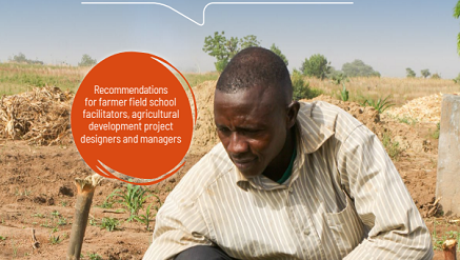
The key to implementing farmer field schools (FFS) is to trigger an experimentation process based on collaboration between a group of farmers and a facilitator. The purpose of this document is to provide project managers, technicians and designers with practical information on how to use the FFS approach and adapt it to their context of intervention to support the agroecological transition (AET). It also will be useful for research staff, leaders of farmers’ organizations (FOs), teachers and students interested in using the FFS approach or better understand its benefits.
The findings and recommendations proposed in this document are the result of a partnership between three institutions working to support AET in the Global South: CIRAD, FAO and the NGO AVSF (Agronomists and Veterinarians Without Borders).
- Published in AGROECOLOGY
Policy Brief -Enabling extension and advisory services to promote agroecology
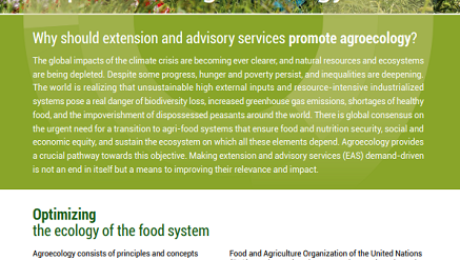
Why should extension and advisory services promote agroecology?
The global impacts of the climate crisis are becoming ever clearer, and natural resources and ecosystems are being depleted. Despite some progress, hunger and poverty persist, and inequalities are deepening. The world is realizing that unsustainable high external inputs and resource-intensive industrialized systems pose a real danger of biodiversity loss, increased greenhouse gas emissions, shortages of healthy food, and the impoverishment of dispossessed peasants around the world. There is global consensus on the urgent need for a transition to agri-food systems that ensure food and nutrition security, social and economic equity, and sustain the ecosystem on which all these elements depend. Agroecology provides a crucial pathway towards this objective. Making extension and advisory services (EAS) demand-driven is not an end in itself but a means to improving their relevance and impact.
- Published in AGROECOLOGY
The Politics of Knowledge

The Global Alliance for the Future of Food commissioned this compendium to gather and uplift the knowledge and evidence on agroecological and regenerative approaches and Indigenous foodways, recognizing that different forms of evidence, knowledge, and expertise are fundamental to shifting mindsets and the basis for action. It brings together the commonly held perspectives, narratives, questions, and gaps in these approaches, and explores ways to mobilize and elevate them to donors, researchers, and policymakers. Through this initiative, the Global Alliance, its members, and the contributing authors seek to better understand, synthesize, and mobilize the evidence base to create enabling environments for agroecology, regenerative approaches, and Indigenous foodways where supportive research, policy, and investments can flourish and benefit all.
- Published in AGROECOLOGY