
National catalogue of soybean varieties in Afghanistan
The national variety catalogue is an official document in which all commercialized crop varieties in the country are registered and their major varietal characteristics listed. It is a valuable reference for public- and private-sector plant breeders, seed producers, and crop producers, as well as seed certification agencies, extension services, and plant variety protection offices.
- Published in AFGHANISTAN, NUTRITION, RESOURCES
Nutrition Sensitive Food Systems in Conflict Affected Regions-A Case Study of Afghanistan
The food systems approach can contribute to food security and reduced malnutrition levels by identifying key investments and policies throughout the food system, including production, processing, marketing, and consumption of food. However, in countries facing fragility and conflict, it has proven difficult to implement such an approach and achieve the desired results. This has been the case in Afghanistan, where high levels of malnutrition stem in part from an undersupply of nutritious food. Multi-sectoral approaches to promote nutrition sensitivity and achieve diet-based solutions have also had only limited impact. This paper reports on an analysis of the nutrition sensitivity of food systems in Afghanistan using multi-sector consultations and gap analyses to examine two key food and nutrition policies, the National Comprehensive Agriculture Development Priority Program and the Afghanistan Food Security and Nutrition Agenda. It highlights gaps in the policies and identifies investment priorities to make food systems more nutrition sensitive. The results show that instilling nutrition sensitivity into the operation of Afghanistan’s food systems can only be accomplished if certain key measures are incorporated into the food system. These include addressing the absence of knowledge in the population regarding healthy diets, the lack of sufficient food for vulnerable populations, weak irrigation systems, capacity constraints at individual and institutional levels, data challenges, and weak natural resource management. In addition, the above weaknesses are compounded by the continued violence and conflict-induced insecurity, weak government, and inadequate investments. Given the role of different sectors in contributing to improved nutrition, appropriate and effective multistakeholder coordination and collaboration is paramount to such efforts.
- Published in AFGHANISTAN, NUTRITION, RESOURCES
Investing in rural people in Afghanistan
IFAD works with small-scale farmers and vulnerable and marginalized socio-economic groups, particularly women and ethnic minorities, in rural and mountain environments. IFAD’s current work in Afghanistan takes into account the difficult security situation across most of the country.
Key intervention domains will include climate-smart small-scale production and value chain development, marketing support, and the promotion of both on- and off-farm economic opportunities for poor and vulnerable rural women, men and youth. Measures to address gender inequality will also be specifically considered and promoted.
- Published in AFGHANISTAN
Strengthened seed regulations and certification system in Afghanistan-2020
Improving smallholder farmers’ access to high-quality seeds is among the key objectives of CGIAR. Achieving this goal requires a conducive policy and regulatory environment. Partnerships between public and private stakeholders for seed certification have proven successful in many countries. In Afghanistan, the engagement of CGIAR with the government resulted in a strengthened seed certification and seed market system through implementation of the public-private-producers partnership business model.
- Published in AFGHANISTAN
Groundwater of Afghanistan (potential capacity, scarcity, security issues, and solutions)

Afghanistan is a landlocked mountainous country with plains in the north and southwest, which is described as being located within South and Central Asia. Water is the lifeblood of the people of Afghanistan, not just for living but also for the economy, which has traditionally been dominated by agriculture. Over 80% of the country’s water resources originate within the Hindu Kush mountain ranges at altitudes over 2000 m. The mountains perform as natural water storage, with snow throughout the winter and snowmelt within the summer that supports perennial flow of all the major rivers.
- Published in AFGHANISTAN
Buy or make? Agricultural production diversity, markets and dietary diversity in Afghanistan
Increasing on-farm production diversity and improving markets are recognized as ways to improve the dietary diversity of smallholders. Using instrumental variable methods to account for endogeneity, we study the interplay of production diversity, markets and diets in the context of seasonality in Afghanistan. We confirm an important seasonal dimension to the interplay. Improved crop diversity over the year is positively associated with dietary diversity in the regular season, but not in the lean season. Livestock species diversity remains important for dietary diversity throughout the year, but particularly so in the lean season when the influence of cropping diversity is low. Market aspects become important for dietary diversity specifically in the lean season.
- Published in AFGHANISTAN, NUTRITION
Improving Access to Irrigation and Strengthening Water Resources Management in Afghanistan
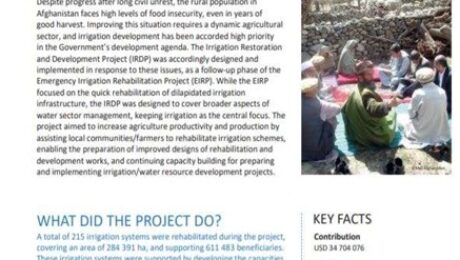
Despite progress after long civil unrest, the rural population in Afghanistan faces high levels of food insecurity, even in years of good harvest. Improving this situation requires a dynamic agricultural sector, and irrigation development has been accorded high priority in the Government’s development agenda. The Irrigation Restoration and Development Project (IRDP) was accordingly designed and implemented in response to these issues, as a follow-up phase of the Emergency Irrigation Rehabilitation Project (EIRP). While the EIRP focused on the quick rehabilitation of dilapidated irrigation infrastructure, the IRDP was designed to cover broader aspects of water sector management, keeping irrigation as the central focus. The project aimed to increase agriculture productivity and production by assisting local communities/farmers to rehabilitate irrigation schemes, enabling the preparation of improved designs of rehabilitation and development works, and continuing capacity building for preparing and implementing irrigation/water resource development projects.
- Published in AFGHANISTAN, NATURAL RESOURCE MANAGEMENT
Climate change vulnerability and adaptation strategies for smallholder farmers in Yangi Qala District, Takhar, Afghanistan
Modelling of climate change scenarios for Pakistan indicates that if agriculture and water management in the Indus River Basin continue in a ‘business as usual’ mode, the increase in temperatures and changes in precipitation will pose serious threats to the future livelihoods of farmers and to the Pakistani agricultural sector. In this context, FAO Pakistan has proposed a project to the Green Climate Fund (GCF) on “Transforming the Indus Basin with Climate Resilient Agriculture and Water Management”. This project is designed to change that by moving away from ‘business as usual’ in the Basin and shifting agriculture and water management to a new paradigm in which producers are successfully adapting to climate change and are able to sustain their livelihoods. The project objective is to transform agriculture in the Basin by increasing resilience among the most vulnerable farmers and strengthening the Government’s capacity to support their communities to adapt. To ensure the success of the project, an appropriate selection of districts for project interventions is a crucial factor. The Technical team at FAO has employed a detailed Multiple Criteria Decision Analysis (MCDA) technique using GIS for the selection of the district areas. As an outcome of the detailed MCDA analysis, a GIS based vulnerability index has been developed for the districts. Based on the vulnerability index, eight districts in Punjab and Sindh are selected for the implementation of the project.
- Published in AFGHANISTAN, CLIMATE CHANGE
Half of Afghanistan’s population faces acute hunger as humanitarian needs grow to record levels
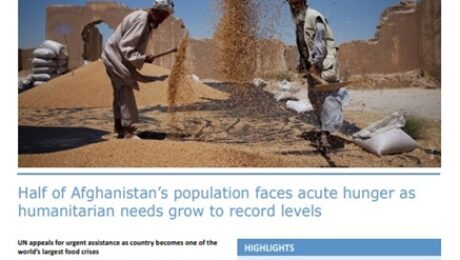
This newsletter compiles the human-interest stories and news releases published in the 4th quarter of 2021 by the FAO Representation in Afghanistan. They include both development and humanitarian work and depict the impact and relevance of FAO’s work in the lives of those farmers, livestock owners, herders and other vulnerable rural people assisted by FAO in Afghanistan.
- Published in AFGHANISTAN