Asia and the Pacific SDG Progress Report 2020

Striking lack of progress on environmental SDGs in Asia-Pacific, reveals new UN report, There is overwhelming evidence that the Asia-Pacific region needs to accelerate action on the Sustainable Development Goals (SDGs) and substantially reverse current negative trends, especially those which are depleting and degrading its environmental resources, according to a new report released today by the United Nations Economic and Social Commission for Asia and the Pacific (ESCAP).
The Asia and the Pacific SDG Progress Report 2020 draws attention to the region’s poor performance on most of the measurable environmental targets of the 2030 Agenda for Sustainable Development. For example, the share of renewable energy has dropped to 16 per cent, one of the lowest rates globally. The region also emits half of the world’s total greenhouse gas – a number which has doubled since 2000. 35 per cent of countries continue to lose their forests.
- Published in GUIDE/TOOLS/MANUALS
A compendium of Technologies, Practices, Services and Policies for Scaling Climate Smart Agriculture in Odisha (India)
Stakeholders engaged in agricultural research for development (AR4D) are increasingly tackling risks associated with climate change in smallholder systems. Accordingly, development and scaling of climate-smart agriculture (CSA) are one of the priorities for all the organizations, departments and ministries associated with the farm sector. Having a ‘one-stop-shop’ compiled in the format of a compendium for CSA technologies, practices and services would therefore serve a guide for all the stakeholders for scaling CSA in smallholder systems.
- Published in GUIDE/TOOLS/MANUALS, INDIA
Indicator Framework for National Extension and Advisory Service Systems Metrics for performance and outcome measurement FAO (2022)
Extension and advisory services (EAS) play a key role in facilitating innovation for sustainable agricultural development. To strengthen this role, appropriate investment and conducive policies are needed in EAS, guided by evidence. It is therefore essential to examine EAS characteristics and performance in the context of modern, pluralistic and increasingly digital EAS systems. In response to this need, the Food and Agriculture Organization of the United Nations (FAO) has developed guidelines and instruments for the systematic assessment of national EAS systems. The Indicator Framework provides overarching guidance on EAS systems assessment, including a list of 40 indicators (10 core and 30 complementary) which cover all major aspects of EAS from inputs to impact. This Indicator Framework provides much needed structure to EAS assessment, taking into account contemporary, pluralistic services and is complemented by FAO’s instruments for participatory data collection in EAS, including quantitative and qualitative data.
- Published in GUIDE/TOOLS/MANUALS, MONITORING & EVALUATION
Bridging the Gap Between Nutrition and Agriculture in Telangana State, India an Assessment of Capacity Within Agricultural Extension and Advisory Services – FAO and GFRAS (2022)
Equipping agricultural extension and advisory services with nutrition knowledge, competencies and skills is essential to promote nutrition-sensitive agriculture. This report presents the results of an assessment of capacity within agricultural extension and advisory services, undertaken in Telangana State, India, with the global capacity needs assessment (GCNA) methodology developed by FAO and GFRAS. The methodology is available online at https://doi.org/10.4060/cb2069en
- Published in EXTENSION AND INNOVATION, NUTRITION
Multi-actor perspectives in extension, education and system-wide innovations
Systemic, multi-actor, user-centric approaches are increasingly used and promoted by innovation policies to meet complex societal challenges that, often, require socio-technical systems transitions or transformations, and for which there are no ‘one size fits all’ innovations (Ingram et al. 2020; Fieldsend et al. 2021). Integration of different knowledge and perspectives is crucial to catalyse transformative forms of innovation, able to promote more sustainable and resilient development pathways aimed at addressing problems, opportunities and challenges. (Beers, Sol, and Wals 2010; Moschitz et al. 2015).
Multi-actor approaches involve a diversity of actors, including end users of innovation, who engage in iterative learning for change processes (Ingram et al. 2020). These processes demand, in many cases, co-production of knowledge and contact with a range of actors in numerous settings and networks at different scale levels (Leeuwis and Arts 2011). Indeed, transformative changes occur when local bottom-up initiatives are aligned with changes in innovation systems at multiple spatial or institutional scales (Moore, Riddell, and Vocisano 2015).
- Published in EXTENSION AND INNOVATION
Transforming Food Systems: Pathways for Country-led Innovation

The need to urgently transition food systems to net-zero, nature-positive that can nourish all people, leaving no one behind is more critical than ever. The COVID-19 pandemic has furthered deepened complex challenges we already face from hunger and nutrition, climate and nature, and societal inequity. Innovation offers a profound opportunity to achieve these transitions and help unlock challenges across food systems. The white paper ‘Transforming Food Systems: Pathways for Country-led Innovation’, published by the World Economic Forum Food Systems Initiative and the Food and Agriculture Organization of the United Nations (FAO), presents an action-oriented roadmap for countries looking to accelerate and scale inclusive innovation that meet the needs of all stakeholders in the food system and support countries to invest in their capability to innovate. The roadmap builds on the work of the Innovation Lever of Change, a key component of the UN Food Systems Summit, hosted by UN Secretary-General António Guterres, in September 2021. The Innovation Lever convened a diverse community of nearly 80 organizational partners representing the public, private and social sectors who promoted the adoption of a wider, more holistic view of innovation – one that is inclusive of local and traditional knowledge; mobilizes national innovation ecosystems, catalyzes institutional and social innovation; and employs fit for purpose technologies such as the power of data and digital solutions.
- Published in EXTENSION AND INNOVATION
Documenting and scaling up knowledge and innovations – Guidelines and templates
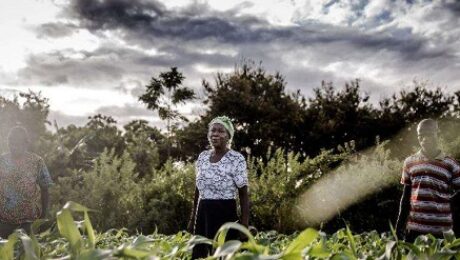
Assessing or understanding the agriculture innovation system (AIS) is an essential step to better understand the needs, new skills and functions needed by the actors and the system. To accelerate the uptake of innovation and progress towards eradicating poverty, there is an urgent need for well-coordinated, demand-driven, and market-oriented information, knowledge, technologies and services.
This document includes a set of information, templates and resources that aim to assist agricultural Innovation systems actors, stakeholders, producers, farmers to develop and share impactful stories. It guides actors and organizations across all sectors in the innovation system to collect and document case studies, success stories, good practices and lessons learned from the project initiatives, trainings and others actions. It highlights scaling-up elements so that other actors can replicate these innovations with a view to scale-up, particularly the stakeholders and actors involved in the DeSira project, through knowledge exchange and sharing.
- Published in EXTENSION AND INNOVATION
Effective approaches and instruments for research and innovation for sustainable agrifood systems
The traditional linear technology transfer model has limited effectiveness in promoting the uptake of technologies and innovations. It fails to account for complexity within the agri-food system, is too simplistic and does not fully consider forward and backward feedback loops in the food system or pay adequate attention to context. There is, therefore, an increasing interest in investors and decision-makers making use of alternative instruments (such as innovation platforms or accelerators) to support innovation processes.
CoSAI commissioned this study to answer the following three key questions:
(1) What types of investment instruments have been tested to support innovation in agri-food systems in the Global South, and how can these be categorized into a working typology?
(2) What is the evidence on how well different instruments have supported SAI’s multiple objectives (e.g. social equality and environmental) at scale and what contextual and design factors affect their success or failure in achieving these objectives (e.g. type of value chain, who participates)?
(3) What advice can be given to innovation investors and practitioners about the instruments selected for different objectives and contexts, and how can selected instruments be designed to achieve better impacts?
- Published in EXTENSION AND INNOVATION
Better instruments and approaches are needed to transform agri-food systems research and innovation
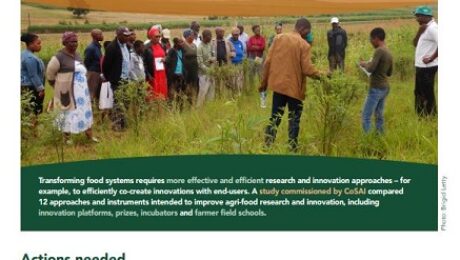
Transforming food systems requires more effective and efficient research and innovation approaches – for example, to efficiently co-create innovations with end-users. A study commissioned by CoSAI compared 12 approaches and instruments intended to improve agri-food research and innovation, including innovation platforms, prizes, incubators and farmer field schools.
- Published in EXTENSION AND INNOVATION
A systemic approach to the decolonisation of knowledge

The authors employ a systems perspective to investigate how coloniality is manifested in the current academic knowledge system and how we can make progress toward the ‘decolonisation of knowledge.’ We reflect on how individual scholars, located in Western donor countries, who benefit from the coloniality of the current knowledge system, can undermine and contest this coloniality with their research and activism. Although we recognise that decolonisation is an ethical issue, we contend that cognitive diversity represents progress and improvements to our pool of knowledge.
- Published in EXTENSION AND INNOVATION