School Food and Nutrition – Global Action Plan 2022–2026

This publication is the result of a collective effort, and includes contributions from relevant technical units of FAO across global, regional and country levels. The development of this plan follows the publication and dissemination of the Organization’s School Food and Nutrition Framework, and provides the implementation roadmap to attain its expected results.
The School food and nutrition – Global action plan seeks to consolidate and guide FAO’s synergistic efforts, setting out priority and concrete outputs to be achieved by 2026. Key activities are presented in the plan and organized according to the following action areas: 1. promote the uptake of and investment in holistic approaches to school food and nutrition (SFN); 2. enhance capacities to design, implement and monitor effective SFN interventions; 3. strengthen policy and legal frameworks that enable SFN implementation; and 4. mobilize resources for ensuring regular and better support to countries. These have been prioritized based on identified gaps and needs, and considering the Organization’s technical competence and organizational comparative advantage. Such activities are meant to be adapted, contextualized and implemented according to regional and national priorities.
READ MORE
- Published in POLICY
Gender, tenure security, and landscape governance
Gender relations shape women’s and men’s identities, norms, rules, and responsibilities. They influence people’s access to, use, and management of land and other natural resources, including ownership, tenure, and user rights to land and forests. A substantial body of research on these issues comes from the CGIAR Research Program on Policies, Institutions, and Markets (PIM), through its Flagship 5 research theme. Flagship 5 focused on gender and social inclusion in relation to land and natural resource tenure and to landscape governance, and analyzed how tenure security affects sustainable management of land, water, fish stocks, and forests. This Food Policy Report reviews the scientific contributions from Flagship 5 to the broader wealth of related literature, including key lessons about gender from these studies with respect to outcomes and impacts on natural resource management, food security, and poverty alleviation.
- Published in GENDER
Research Series 73: Food systems and rural wellbeing: challenges and opportunities

This paper provides a framework for assessing the dynamics of rural wellbeing and food systems change. It provides a synthesis of over 840 recommendations made in recent international reports on the linkages between food systems and rural development. It also looks at the viability of small-scale farming and the diversification of livelihood options needed to overcome rural poverty and inequality.
- Published in POLICY
Repurposing Agricultural Policies and Support

The report finds that repurposing a portion of government spending on agriculture each year to develop and disseminate more emission-efficient technologies for crops and livestock could reduce overall emissions from agriculture by more than 40 percent. Meanwhile, millions of hectares of land could be restored to natural habitats. The economic payoffs to this type of repurposing would be large. Redirecting about $70 billion a year, equivalent to one percent of global agricultural output, would yield a net benefit of over $2 trillion in 20 years.
- Published in POLICY
Increasing stakeholder participation in forest law reform process-Case studies from FAO-EU FLEGT Programme
The FAO-EU FLEGT Programme is carrying out an experience capitalization exercise to collect, analyse and share experiences, good practices and lessons learned during the implementation of the Phase III of the Programme. As a part of this effort, the Programme agreed to support the project entitled “Increasing Stakeholder Participation in Forest Law Reform Process: Case Studies from FAO-EU FLEGT Programme”. This project, carried out and co-financed by ClientEarth, includes a review of nine projects that focused on increasing stakeholder participation in legal reform processes in the following countries: the Republic of Congo, Cote d’Ivoire, Liberia, Malaysia, Myanmar and the Philippines. The publication includes the aggregate findings of the six focus countries, general analysis and recommendations.
- Published in POLICY
Tackling inequalities in public service coverage to “build forward better” for the rural poor
this policy brief specifically focuses on tackling rural inequalities in public service coverage. Drawing evidence from across sectoral domains, the policy brief explores the manifestations of, causes of, and means to redress inequitable public service coverage within rural areas as well as between rural and urban areas. The primary target audiences for this policy brief are policy-makers, planners and development partners.
- Published in POLICY
Strengthening Local Self Governance in Jharkhand
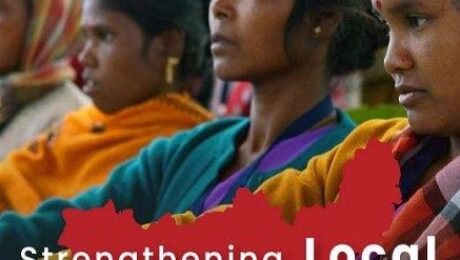
This document is prepared to illustrate the process of implementation of GSA from December 2017 to November 2020 in Jharkhand undertaken by PHIA and partner organisations with funding support from Azim Premji Philanthropic Initiative. This document is prepared as a best practice for knowledge sharing and as a tool for practitioners and policy makers to replicate and scale the initiative in a similar context. It is a step-by-step guide for promoting the agenda of local self-governance and boosting local democracy by following a systemic process and set of interventions.
- Published in POLICY
The role of extension and financial services in boosting the effect of innovation investments for reducing poverty and hunger: A DEA approach
Increasing investment and spending in agricultural innovation is not enough to meet Sustainable Development Goal (SDG) targets of ending poverty and hunger because the effectiveness of investments in low- and middle-income (LMI) countries is affected by the low quality of infrastructure and services provided, and by different norms and practices that create a considerable gap between financing known technical solutions and achieving the outcomes called for in the SDGs. As an important part of a nation’s common innovation infrastructure, financial and extension services are major “enablers” of investments, favorably contributing to national innovative capacity. However, the contribution of these services to innovation in LMI countries has been limited. Financial services in LMI countries face low rates of return; high risks and lack of acceptable collateral; and limited outreach in rural areas. Similarly, the performance of extension services has been affected by ineffective and costly strategies that have promoted rigid recommendations with poor understanding of how farmers learn and lacked context-specific focus on solving problems.
- Published in EXTENSION AND INNOVATION, POLICY
Investing In Farmers: Agriculture Human Capital Investment Strategies FAO (2021)

Investing in farmers – or agriculture human capital – is crucial to addressing challenges in our agri-food systems. A global study carried out by the FAO Investment Centre and the International Food Policy Research Institute, with support from the CGIAR Research Programme on Policies, Institutions and Markets and the FAO Research and Extension Unit, looks at agriculture human capital investments, from recent trends to promising initiatives in Cameroon, Chile, Côte d’Ivoire, India, Indonesia, Kenya, Peru, Rwanda and the United States of America. It also includes 11 shorter case studies, ranging from pastoralist training centres to the inclusion of indigenous communities. The global study aims to provide governments, international financing institutions, the private sector and other partners with the evidence and analysis needed to make more and better investments in agriculture human capital. This publication is part of the Directions in Investment series under the FAO Investment Centre’s Knowledge for Investment (K4I) programme.
- Published in POLICY
Farmers and scientists in AR4D: Looking at a watershed management project through an STS lens
Agricultural Research for Development (AR4D) provides the interface for the meeting of farmers and scientists. This is a meeting of different social worlds, contesting agendas, cultures of cooperation and networks of actors. Like in other disciplines, scientists in AR4D have developed their own culture of science. However, the role of their culture of science in the negotiations and encounters with farmers’ social worlds is rarely discussed. Analysing AR4D with a theoretical framework based on Science and Technology Studies (STS) helps us to highlight important issues of power and access in AR4D. The goal of this paper is to demonstrate how the introduction of certain technologies has interacted with the lives of people in an AR4D project in Ethiopia, and to highlight the potential and limitations of applying STS to AR4D. We interviewed farmers, scientists, extensionists, policy makers and donors associated with an AR4D project in the Ethiopian Highlands using qualitative social research approaches. Akrich’s theory on scripts provided the theoretical framework for analysis. Our findings provide examples for the re-inscription of technology and access in an AR4D project, leading to trade-offs and shifting of power between different actors. We conclude that understanding AR4D as part of a network of actors with its own culture of science provides an essential learning ground. We recommend STS to be applied more widely in AR4D to explore the nature of these networks to highlight what makes technology work for users in the long term.
- Published in POLICY